A solar client doesn't only want a price. They want to know what they are buying, how much it saves and when it pays for itself. A quote that lists "10 kW solar system" with one lump sum answers none of that, and the client goes to the next installer who explains it better.
This free solar quotation format puts the answers on one page. It splits the system into modules, inverter, structure and cables, then calculates the cost per kW, annual savings and a simple payback period from your numbers. It suits rooftop solar installers and EPC firms in India, Australia, New Zealand and the UAE. Use the form on this page to get your free copy.
What is a solar quotation format?
A solar quotation format is a standard layout for pricing a solar installation. It lists the system size, each component with quantity and rate, tax, the total, payment stages and warranty. A good one also shows expected savings, so clients compare offers on value, not just price.
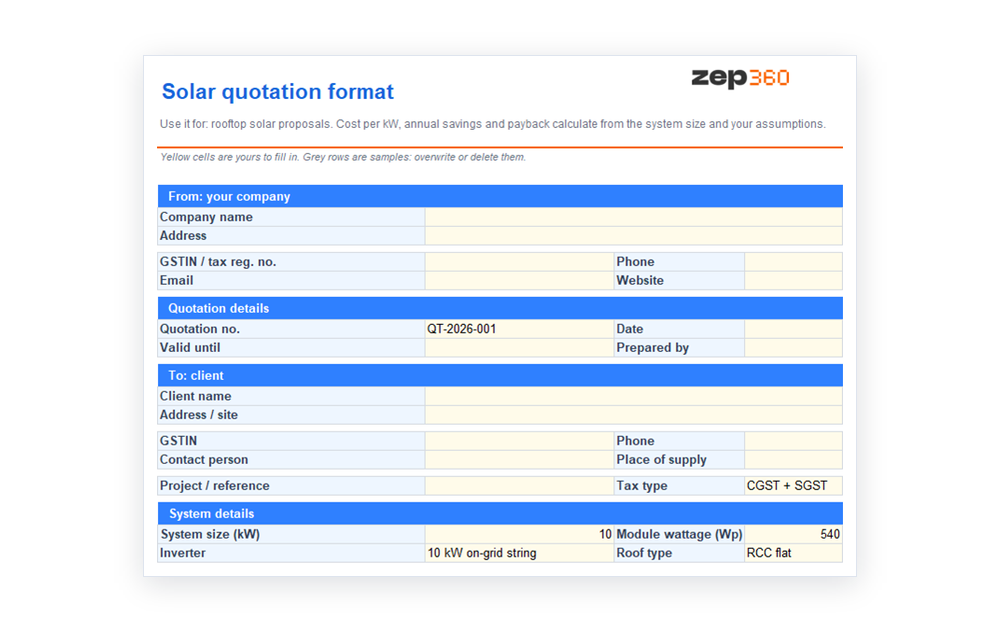 The template is an Excel workbook, so every total is a formula. Change the system size or a module price, and the cost per kW and the payback update at once. A Word version is useful when you want a formal letter, and our quotation format in Word covers that.
What is inside the template
- System details: system size in kW, module wattage, inverter, roof type and net metering approach.
- Bill of materials: modules, inverter, mounting structure, cables and connectors, protection boxes, earthing and lightning arrestor, installation, and net metering liaison, each as its own line.
- Tax by line: a tax rate on every item, with a drop-down for CGST and SGST, IGST or a single tax.
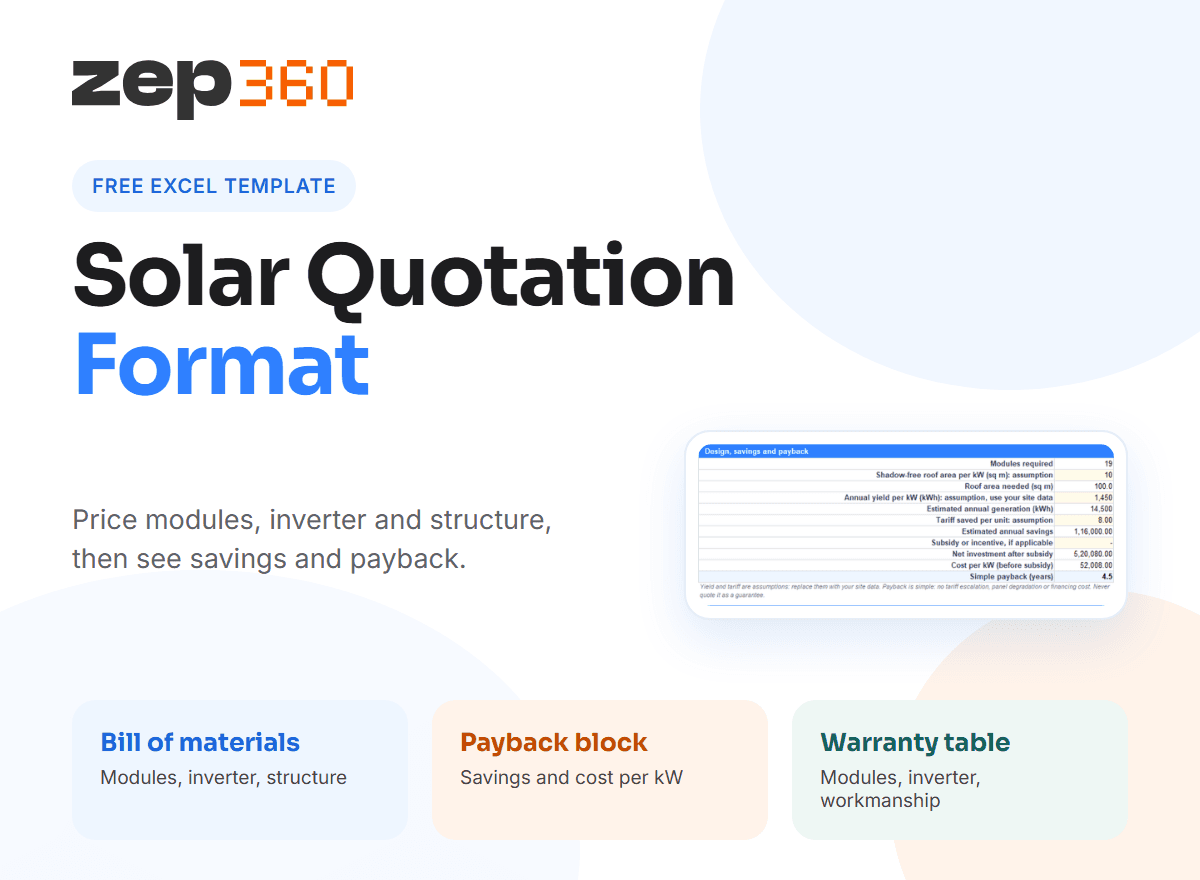
- Design, savings and payback block: modules required, roof area, annual generation, savings, net investment, cost per kW and simple payback.
- Warranty table: separate lines for module product warranty, module performance warranty, inverter and workmanship.
- Payment schedule, bank details and terms: stages as percentages, with the amounts calculated.
The sample rows are grey. They show a 10 kW system as an example, and the prices, HSN or SAC codes and tax rates are placeholders, so replace them with your own and confirm tax with your adviser.
What a solar quotation must include
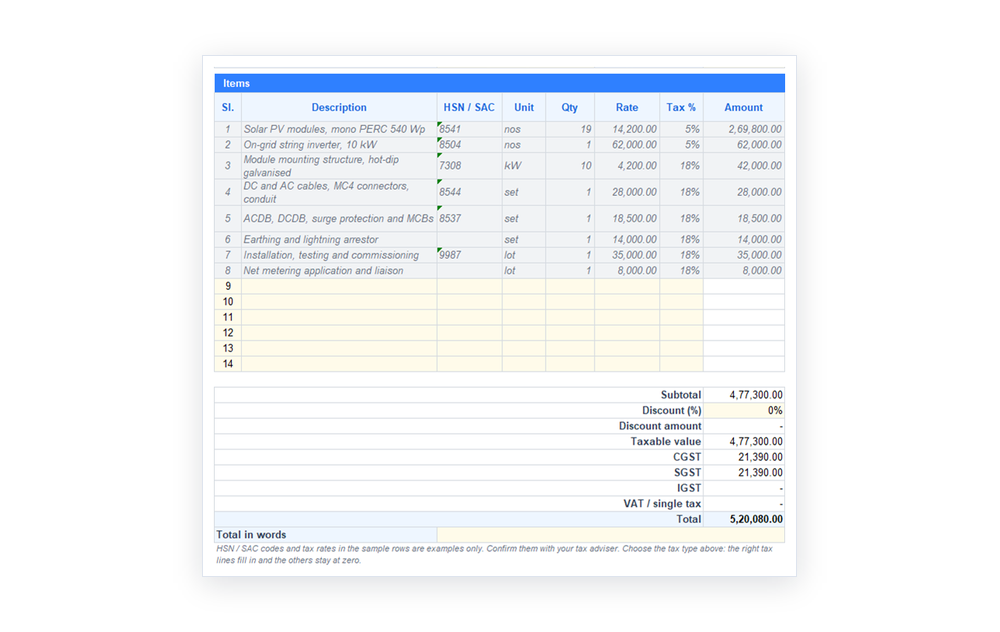 Clients compare solar quotes line by line, so each one should answer the same questions.
- System size and components: kW rating, module make and wattage, number of modules, and the inverter make and rating.
- Roof and structure: the roof type, the area needed and the mounting structure.
- What is included: installation, testing, commissioning and the net metering application.
- What is not included: roof strengthening, shadow removal, long cable runs and utility fees, unless you state them.
- Warranty: product and performance cover for modules, the inverter and your workmanship.
- Payment stages and validity: because module and inverter prices move, say how long the quote holds.
Keep the scope exact. A site survey before the quote tells you the roof area, shading and structure, and it prevents surprises after the order.
How the savings and payback block works
The block turns a handful of inputs into the figures clients ask for. You enter three assumptions, and the sheet does the rest.
- Roof area per kW: the shadow-free area one kW needs. The template starts at 10 sq m as an assumption.
- Annual yield per kW: the units one kW produces in a year. It starts at 1,450 kWh and should come from your site data.
- Tariff saved per unit: what each generated unit saves the client.
From these, the sheet works out the number of modules, the roof area, the annual generation and the annual savings. It subtracts any subsidy or incentive from the total to give the net investment, then divides net investment by annual savings for a simple payback in years. With the sample figures, a 10 kW system comes to a cost of 52,008 per kW and a payback of 4.5 years.
Treat payback as an estimate
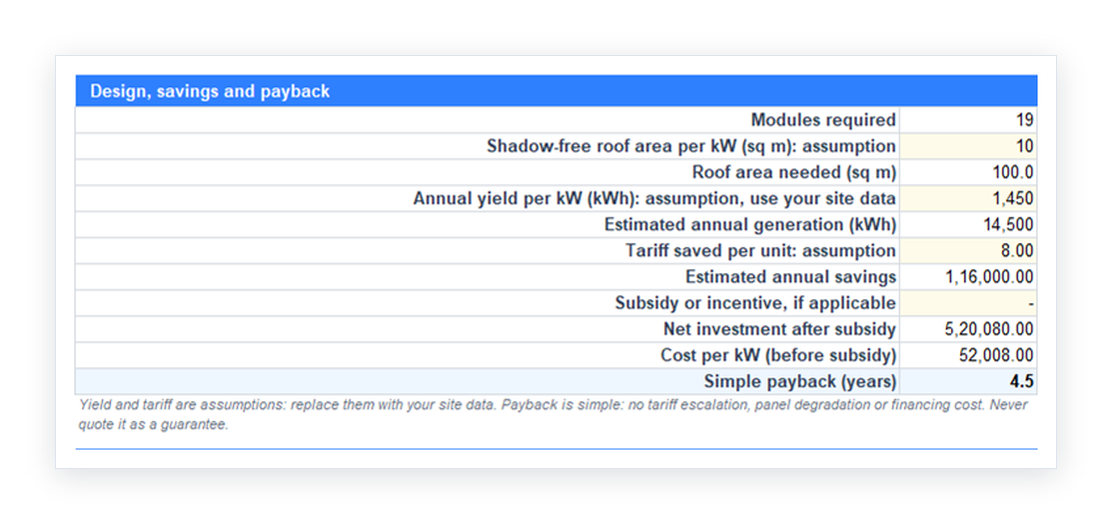 Simple payback ignores tariff increases, panel degradation and financing cost. Generation also changes with shading, tilt, soiling and weather. So present it as an estimate, never a guarantee, and use real site data for the yield. If you want to read about renewable energy programmes, the Ministry of New and Renewable Energy publishes the national information.
How to use the template
- Run the site survey and note the roof type, area, shading and structure.
- Enter the system size and module wattage, then list each component with quantity and rate.
- Choose the tax type and set the tax rate on each line.
- Replace the three assumptions with your site data, and add any subsidy.
- Check the warranty table and the payment stages.
- Save a PDF and send it with a short covering note.
Common solar quoting mistakes
- A lump sum with no breakdown: the client cannot compare it, so they push for a discount.
- Quoting generation as a promise: weather and shading make it an estimate.
- Mixing tax rates on one line: equipment and installation often carry different rates, so keep them on separate lines.
- Leaving out exclusions: extra cable runs and roof work then become your cost.
- No validity date: module prices can move while the quote sits open.
For the EPC side of the job, our EPC guide explains how engineering, procurement and construction fit together, and the bill of quantities guide shows how a component list becomes a project budget. The tax rules are on the GST portal and the CBIC site.
From template to a solar sales workflow
A spreadsheet handles one quote at a time. A solar business needs the whole sequence: enquiry, site survey, quotation, follow-up and close. In ZEP Sales, quotation templates are specific to the trade, so a solar quote calculates differently from a construction or interior quote. Each quote keeps its version history and status, and a signed quote carries into ZEP Projects as an execution-ready project. Book a ZEP360 demo to see it with your own solar pricing.
More free templates
For a general layout, use the quotation format in Excel. For other trades, see the construction quotation format and the electrical quotation format. The full guide to quotation format links to the whole set.
Frequently Asked Questions
Is there a free solar quotation format?
Yes. This page has a free solar quotation format in Excel. It lists modules, inverter, structure and cables, then calculates cost per kW, annual savings and simple payback. You can edit every price, rate and assumption.
What should a solar quotation format include?
Include the system size, module and inverter details, a line-by-line bill of materials, tax, the total, a payment schedule, warranty terms, inclusions and exclusions, and a validity date. Add expected generation as an estimate, not a promise.
How do I calculate payback in a solar proposal template?
Divide the net investment by the annual savings. Annual savings come from yearly generation times the tariff saved per unit. It is a simple estimate that ignores tariff changes and panel degradation, so label it clearly.
Can I use this solar quotation format in Word?
The template is an Excel workbook so the calculations work. To send a letter, copy the totals into our Word quotation, or save the Excel sheet as a PDF and attach it to your covering note.
How often should I update a solar installation quotation?
Review it whenever module, inverter or cable prices change, and set a short validity period, such as 15 days. Re-run the payback with fresh yield and tariff numbers for each client.
Get complete visibility of every project site.
Switch to ZEP360 and discover a unified way to manage your business.
Book a Demo