In construction, a quote is more than a price. It sets how the work is measured, how it is paid and what happens when the scope changes. A vague quote leads to arguments at the first running bill, and the contractor usually loses those arguments because nothing was written down.
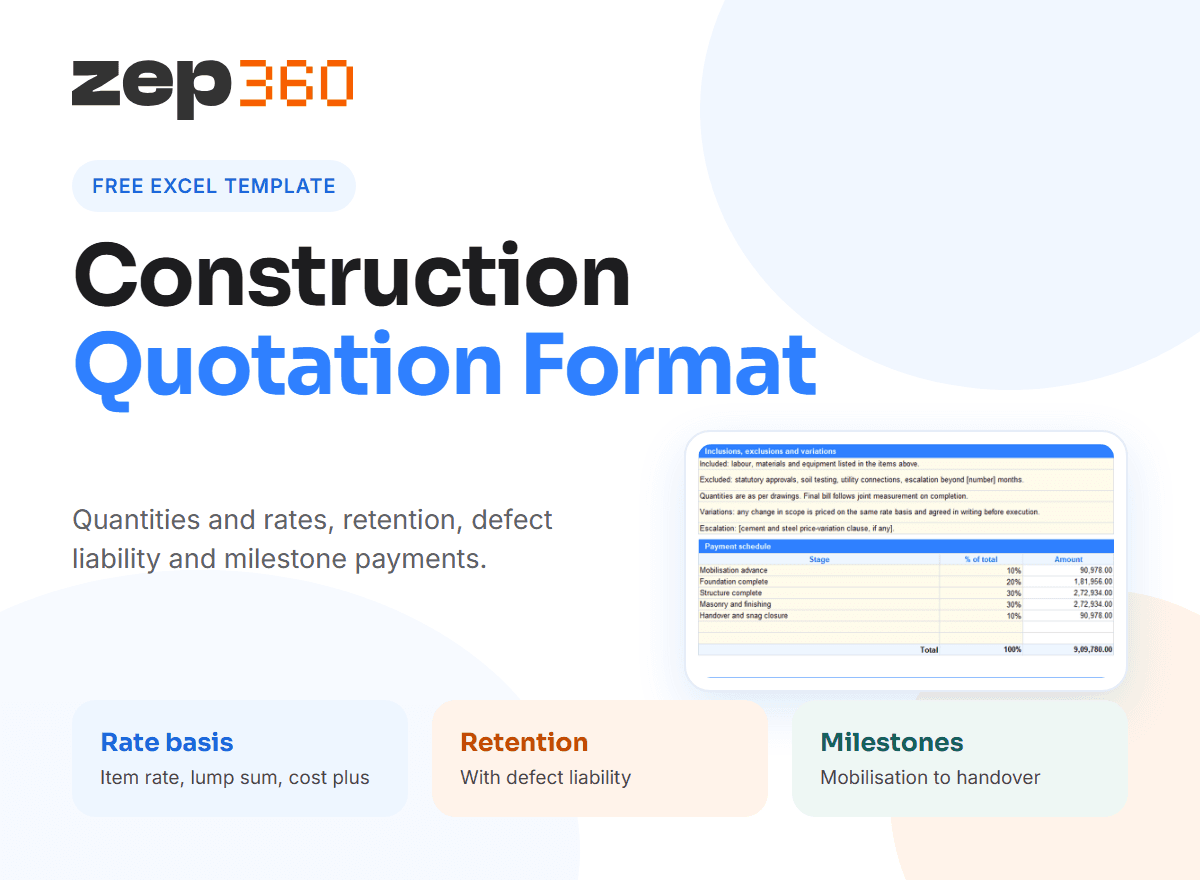
This free construction quotation format covers the commercial basis as well as the rates. It lets you price civil and building work by quantity and rate, state the rate basis, set retention and defect liability, and lay out milestone payments. It suits contractors in India, Australia, New Zealand and the UAE. Use the form on this page to get your free copy.
What is a construction quotation format?
A construction quotation format is a standard layout for pricing building or civil work. It lists items with unit, quantity and rate, states the rate basis such as item rate or lump sum, adds tax, and sets payment milestones. It gives the client a clear price and you a clear scope.
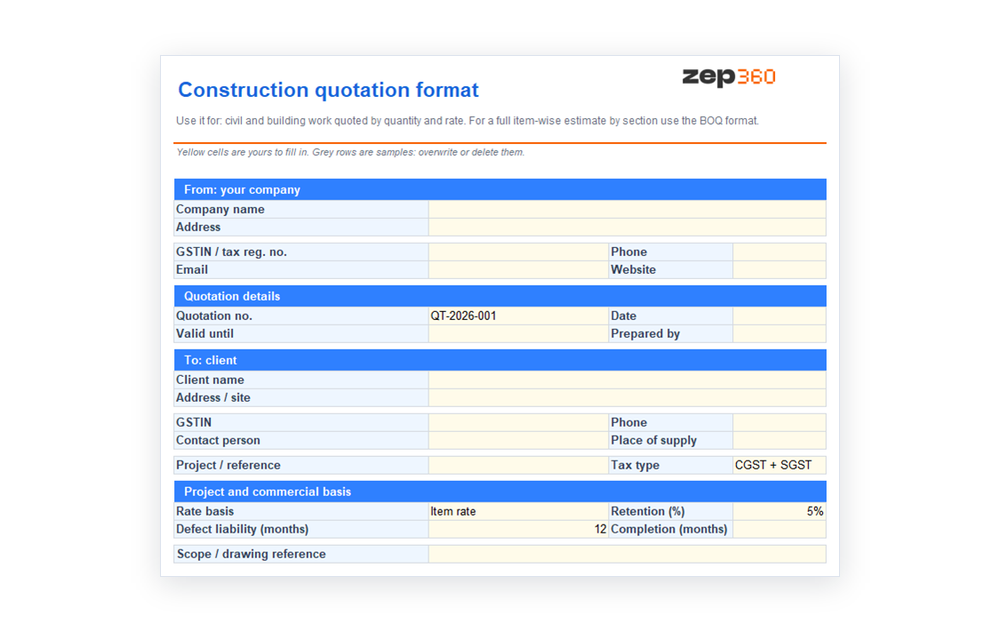 The template is an Excel workbook, so quantities, rates, tax and totals are formulas. For a full item-wise estimate split by trade section, use a bill of quantities, and our bill of quantities guide explains how it works.
What is inside the template
- Commercial basis: a drop-down for item rate, lump sum or cost plus, plus retention percentage, defect liability in months and the completion period.
- Scope reference: a field for the drawing or specification number the price is based on.
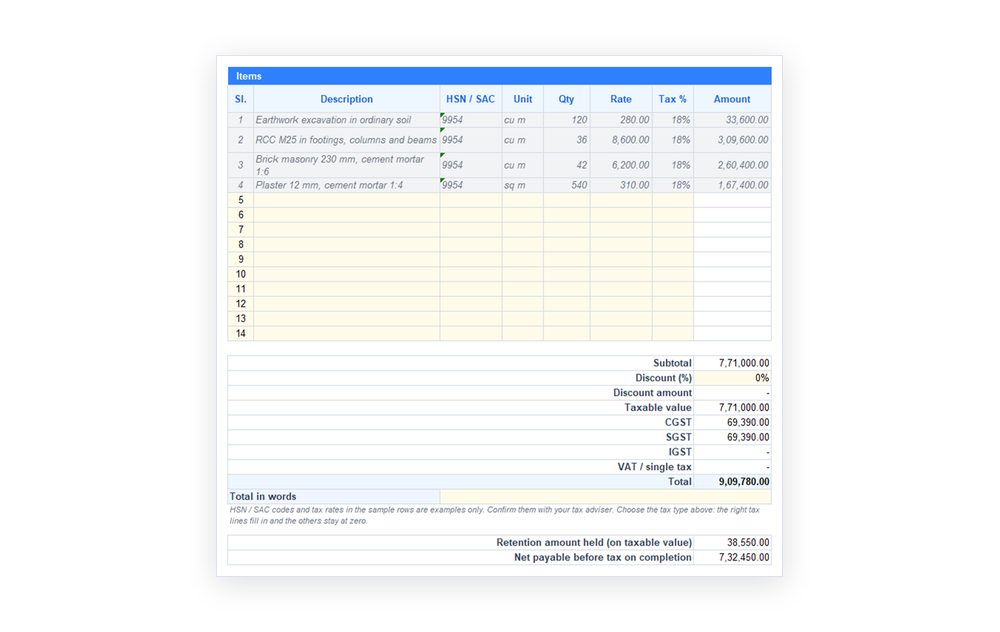
- Items: description, HSN or SAC code, unit, quantity, rate and a tax rate on each line.
- Retention amount: shown under the totals, so you see what is held back until the defect liability period ends.
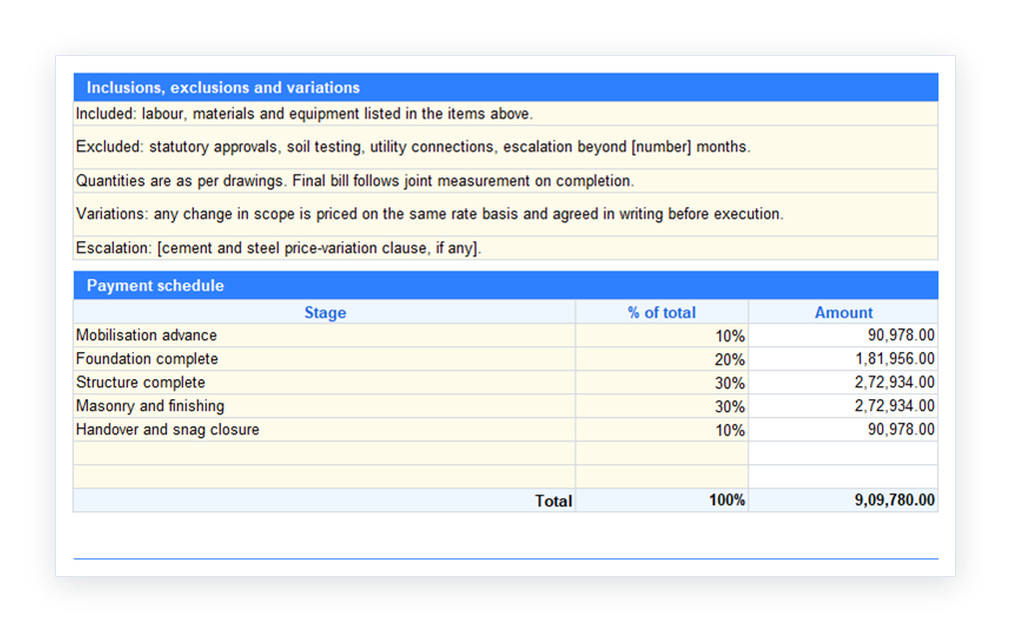
- Inclusions, exclusions and variations: lines for what the price covers, what it excludes and how changes are priced.
- Milestone payment schedule: mobilisation, foundation, structure, masonry and finishing, and handover, each as a percentage with the amount calculated.
The sample rows show earthwork, RCC, brick masonry and plaster. The rates, tax rates and codes are placeholders, so use your own and confirm tax with your adviser.
Choose the rate basis first
 The rate basis decides how the final bill is worked out, so agree it before you list a single item.
- Item rate: you quote a rate per unit, and the final bill follows measured quantities. It suits work where quantities may change.
- Lump sum: you quote one price for a defined scope. It suits work with fixed drawings, but any change needs a variation.
- Cost plus: the client pays actual cost plus an agreed margin. It suits work that cannot be scoped yet.
Write the basis in the quote, because each one allocates risk differently. With an item rate, the client carries the quantity risk. With a lump sum, you carry it.
Retention, defect liability and milestones
Retention is a percentage of each payment, held back until the defect liability period ends. The template starts at 5%, and you can change it. It shows the retention amount under the totals so both sides see the number. Defect liability is the period after completion during which you fix defects at your own cost, and the template records it in months.
Milestone payments tie money to progress. A typical set is mobilisation, foundation complete, structure complete, masonry and finishing, and handover. The template starts with 10%, 20%, 30%, 30% and 10% as an example. Tie each stage to something you can both inspect, and use a completion certificate at the end to record that the work is finished as agreed.
What a construction quotation must include
 Your details, the client's details, a quote number and the date
- A written scope of work and the drawing reference it follows
- Items with unit, quantity, rate and tax, based on measurable quantities
- The rate basis, retention, defect liability and completion period
- Who supplies cement, steel and other key materials
- Exclusions such as approvals, soil testing and utility connections
- Variation and escalation terms, and a validity date
Joint measurement matters. State that the final bill follows joint measurement on completion, so both sides measure the same work. For rates, many contractors refer to published schedules, and the CPWD website is a common reference point in India. For standard contract terms, IBM's overview of contract management is a useful read, and the GST rules are on the GST portal.
Common construction quoting mistakes
- No rate basis: the first running bill becomes an argument.
- Quantities without a drawing reference: nobody can check them.
- Unclear material supply: you price steel the client thought they would buy.
- No variation rule: extras get done on a phone call and never get paid.
- Missing escalation terms: a rise in material prices eats the margin.
From template to a project workflow
A quote is only the start of a construction job. After signing, you need the BOQ, the budget, material requests and running bills tied to the same figures. In ZEP Sales, a quote is built from the survey data, and its version history and status are tracked. A signed quote and its BOQ then carry into ZEP Projects, where progress and cost are tracked against the approved BOQ. Our job costing guide explains why that comparison matters. Book a ZEP360 demo to see it with your own quote.
More free templates
For a general layout, use the quotation format in Excel. For related work, see the BOQ format and the work order format. The full guide to quotation format links to every template.
Frequently Asked Questions
Is there a free construction quotation format?
Yes. This page has a free construction quotation format in Excel. It handles quantities and rates, a rate basis drop-down, retention, defect liability, tax and a milestone payment schedule. You can edit every line.
What should a work quotation format include for civil work?
Include the scope and drawing reference, items with unit, quantity and rate, the rate basis, tax, retention, defect liability, material supply, exclusions, variation terms, the payment milestones and a validity date.
What is the difference between item rate and lump sum?
With an item rate, you quote a rate per unit and the bill follows measured quantities. With a lump sum, you quote one price for a defined scope. Lump sum shifts quantity risk to the contractor.
How much retention should a contractor quote?
The template starts at 5% as an example, but the right figure depends on your contract. Agree the percentage and the release date with the client, and write both in the quote.
Can I use this contractor quotation format for a small repair job?
Yes. For a small job, list a few items, choose lump sum and skip the milestones. The same template works for a single repair as well as a full building.
Get complete visibility of every project site.
Switch to ZEP360 and discover a unified way to manage your business.
Book a Demo