Electrical quotes go wrong in two places. Materials are priced from memory, and labour is lumped in so nobody can see it. When copper rises or the scope grows, the contractor cannot show where the cost moved, and the client sees only a higher number.
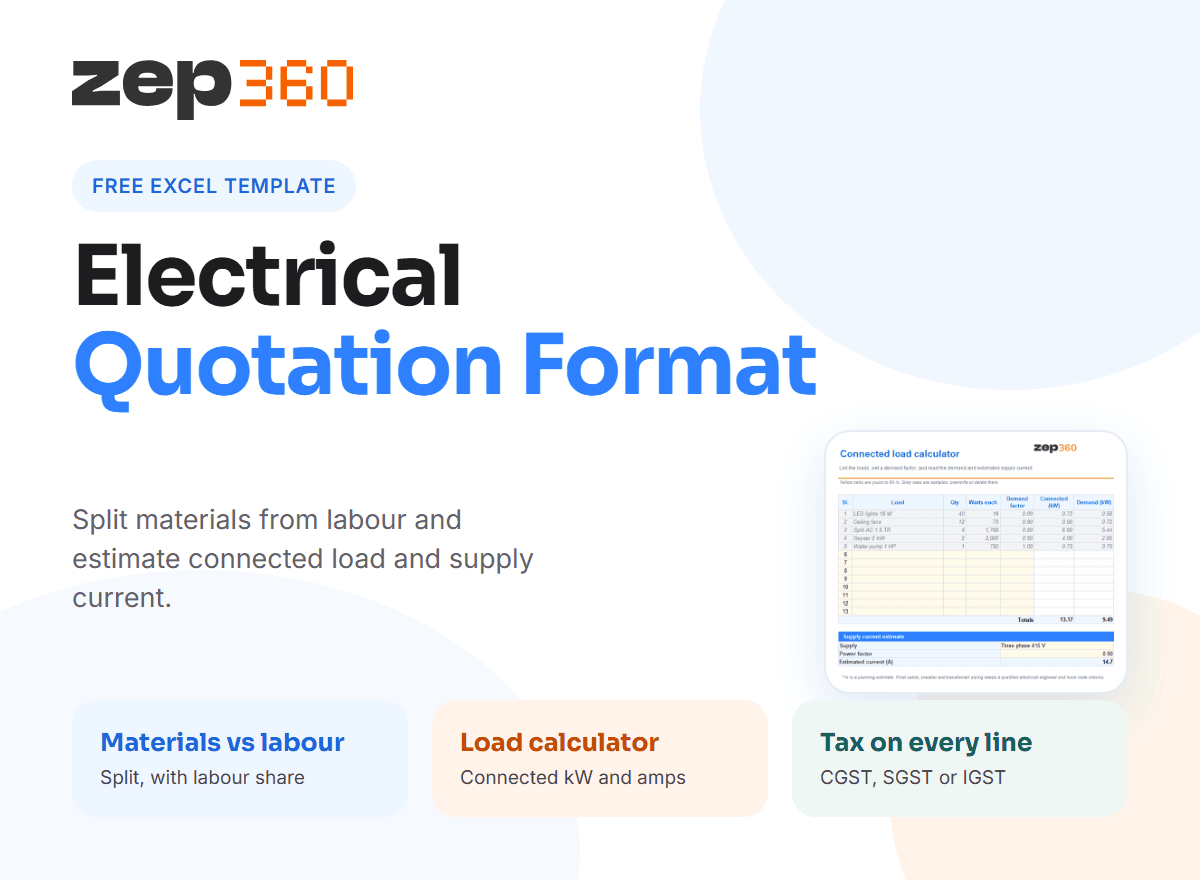
This free electrical quotation format separates materials from labour, adds tax on each line, and includes a load calculator that estimates connected load and supply current. It suits electrical contractors and wiring teams in India, Australia, New Zealand and the UAE. Use the form on this page to get your free copy.
What is an electrical quotation format?
An electrical quotation format is a standard layout for pricing electrical work. It lists materials and labour as separate lines with unit, quantity and rate, adds tax, states the load and supply, and sets payment terms, testing and warranty. A clear split lets the client see what they pay for.
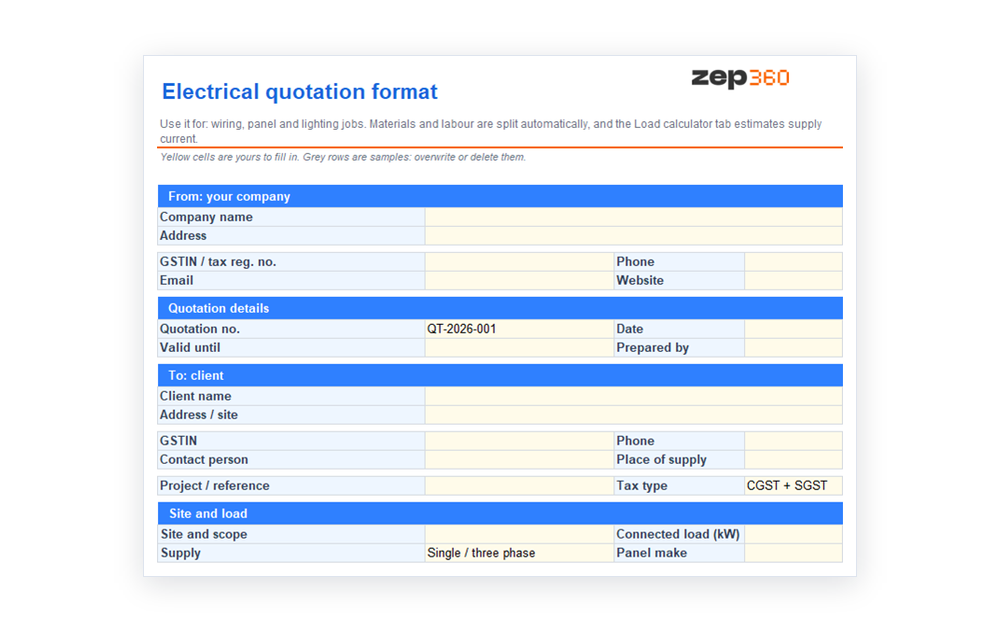 The template is an Excel workbook with two tabs, the quotation and a load calculator. Totals, tax and the materials and labour split are formulas.
What is inside the template
- Site and load block: site and scope, connected load, supply type and panel make.
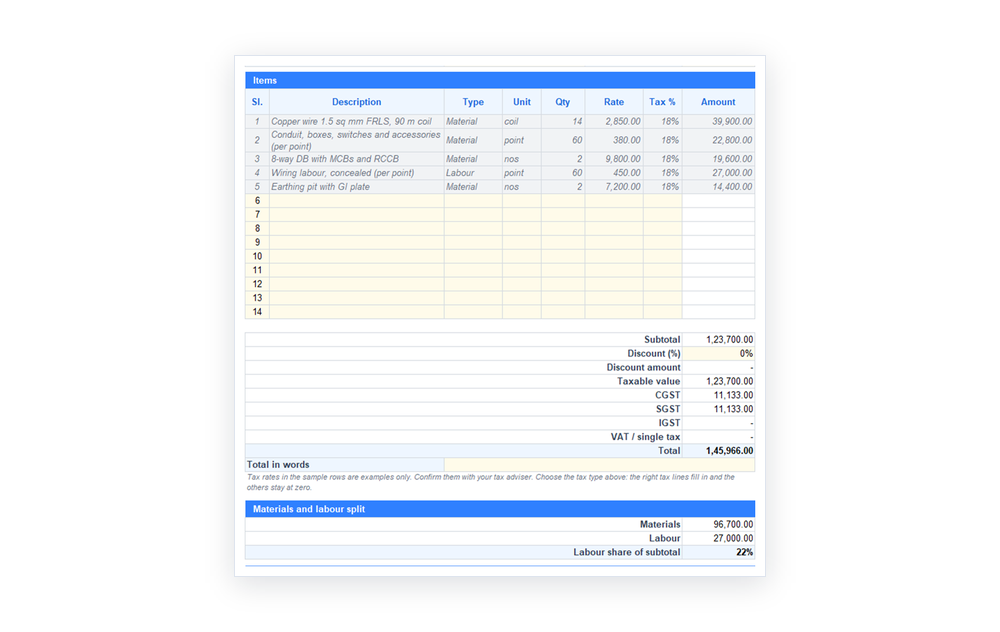
- Items with a type column: each line is marked Material or Labour from a drop-down, with unit, quantity, rate and tax.
- Materials and labour split: the totals for materials and for labour, plus labour as a share of the subtotal.
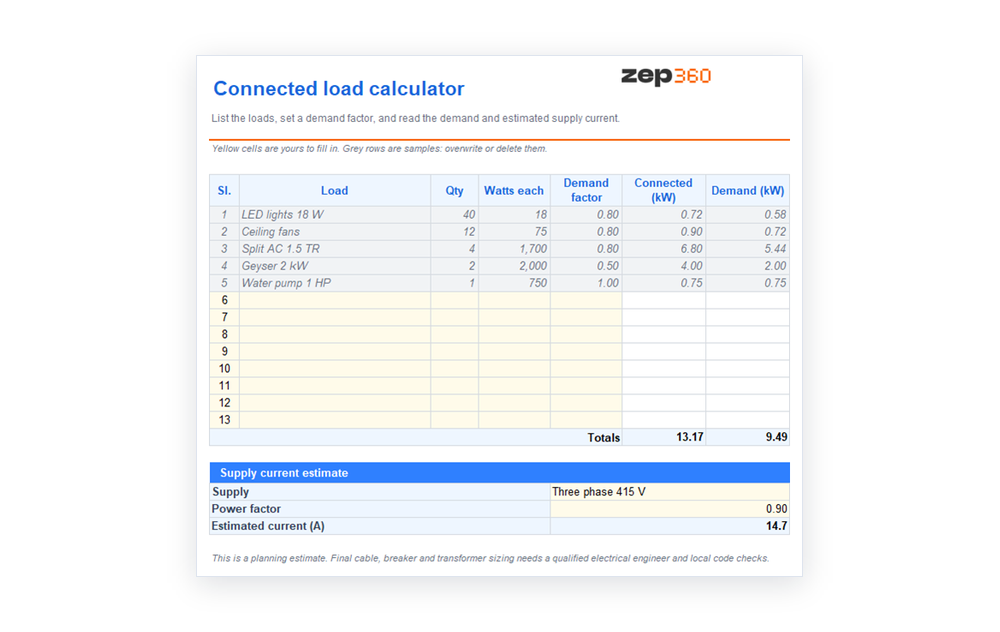
- Load calculator tab: loads with quantity, watts and demand factor, giving connected kW and demand kW, then an estimated supply current.
- Payment schedule and terms: an advance, material delivery and testing and handover, with warranty and exclusions.
The sample rows show wire, accessories, a distribution board, labour per point and earthing. The prices and tax rates are examples only, so use your own and confirm tax with your adviser.
Why split materials from labour
 Materials move with the market, and labour moves with scope and time. Keeping them apart lets you re-price copper or cable without touching the labour, and it shows the client where the money goes. It also helps you check your own margin. If labour is only a small share of the subtotal on a job that took weeks, the quote was too low.
Price by point or by item
Wiring is often priced per point, such as a light point, a fan point or a socket. Panels, boards and earthing are priced per item. The template supports both, because each line has a unit and a rate. Keep the point definition clear, for example whether a point includes the switch, the conduit and the wire run, so the client and the team read it the same way.
How the load calculator works
The load calculator turns a list of appliances into a planning estimate. For each load, enter the quantity, the watts and a demand factor.
- Connected load (kW) equals quantity times watts, divided by 1,000.
- Demand (kW) equals connected load times the demand factor.
- Supply current for a single-phase 230 V supply equals demand in watts divided by 230 times the power factor.
- Supply current for a three-phase 415 V supply equals demand in watts divided by 1.732 times 415 times the power factor.
Pick the supply type and set the power factor, which starts at 0.9. The sheet then shows the estimated current in amps. Treat the result as a planning aid. Final cable, breaker and transformer sizing needs a qualified electrical engineer and your local code.
What an electrical quotation must include
 Your details, the client's details, and a quote number and date
- The scope, with the number of points, the panels and the earthing, written as a scope of work
- Materials and labour as separate lines with unit, quantity, rate and tax
- The load and supply assumptions
- Testing and test reports on completion
- Exclusions, such as civil chasing and making good, utility connection fees and backup changeover
- Payment stages, warranty on workmanship and the validity date
A site survey before the quote gives you the point count and cable runs. Electrical work also sits inside larger services, and our MEP guide explains how electrical, mechanical and plumbing fit together. For energy efficiency in buildings, the Bureau of Energy Efficiency publishes national guidance.
How to use the template
- Survey the site and count points, boards and runs.
- List each material and labour line, and mark its type.
- Choose the tax type and set the tax rate on each line.
- Use the load calculator to record the connected load and supply.
- Check the materials and labour split and the payment stages.
- Save a PDF and send it with a short covering note.
Common electrical quoting mistakes
- Labour hidden in material rates: you cannot re-price either.
- Copper priced once and forgotten: a rise in cable cost eats the margin.
- No definition of a point: the client expects more per point than you priced.
- Skipping testing: the client asks for reports you did not budget for.
- No exclusions: civil work and making good get assumed.
Tax rules for the quote are on the GST portal and the CBIC site. Keep material stock tied to your jobs, because purchase orders and issue records show what each job really used.
From template to a workflow
A spreadsheet prices one job at a time. When you run several jobs, you need the survey, the quote, the material list and the stock in one place. In ZEP Sales, the team captures the enquiry, schedules the survey and builds the quotation from the survey data, with version history and status. A signed quote carries into ZEP Projects, and ZEP Inventory tracks materials against the job. Book a ZEP360 demo to see it with your own rates.
More free templates
For a general layout, use the quotation format in Excel. For related trades, see the construction quotation format and the solar quotation format. The full guide to quotation format links to every template.
Frequently Asked Questions
Is there a free electrical quotation format?
Yes. This page has a free electrical quotation format in Excel. It splits materials and labour, adds tax on each line, and includes a load calculator for connected load and supply current.
What should an electrical quote template include?
Include the scope, points and boards, materials and labour as separate lines, the load and supply, testing, tax, payment stages, exclusions, warranty and a validity date.
How do I calculate connected load for an electrical quotation?
Multiply each appliance's quantity by its watts and divide by 1,000 for kW. Add them up, then apply a demand factor. The template's load calculator does this and estimates the supply current.
Should an electrical wiring quotation show materials and labour separately?
Yes. Separate lines let you re-price materials when copper moves, show the client where the money goes and check your labour margin. Mark each line as Material or Labour in the template.
Can I use this quotation for electrical work on a large project?
Yes, for a defined package. For large projects, pair it with an item-wise BOQ and a work order for each subcontractor, and track the cost against the approved scope.
Get complete visibility of every project site.
Switch to ZEP360 and discover a unified way to manage your business.
Book a Demo