

Get complete visibility of every project site.
Switch to ZEP360 and discover a unified way to manage your business.
Book a Demo
- Field Service Management
The best field service management software depends on the size of your team and the work you sell. A five-person plumbing crew needs a different tool than a 200-technician maintenance company. This guide lists 20 top tools for 2027 and shows who each one suits.
You'll find a quick-reference table, short profiles of every tool, the key features to check and a five-step way to build a shortlist.
We also build field service management software, so we flag where ZEP360 fits and where it doesn't. We don't compare prices here, because vendors change them often.
What is field service management software?
Field service management software runs the field service operations that happen away from your office. It takes in service requests, books the right job for the right technician and records what your field technicians did. It then bills the customer. Our glossary explains field service management in more detail.
Most tools share the same core software features.
- Dispatch: The system assigns each job by skill, location and availability.
- Work orders: Every visit becomes a record with tasks, photos, parts and sign-off. Our guide to work order management shows how that record works.
- Mobile access: Service technicians open job details, update status and capture signatures on mobile devices.
- Billing: The finished job turns into an invoice, and managers see how each team performed.
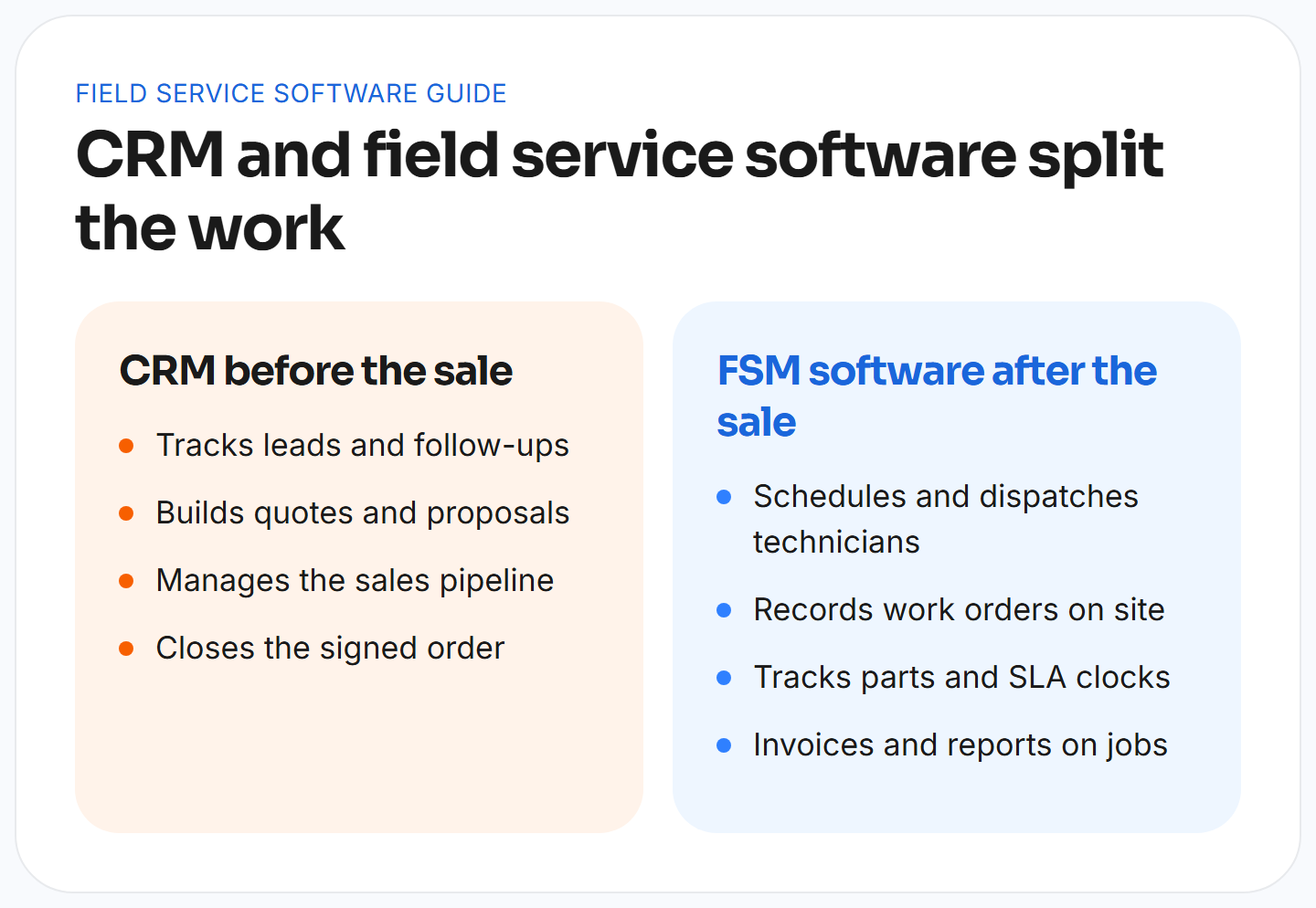
People often ask how this differs from customer relationship management. A CRM manages the sale, with leads, follow-ups and quotes. FSM software manages service delivery after the sale.
ZEP360 is a unified field service management system that bundles both, which saves re-typing customer information.
How field service management software works
 The loop behind your daily operations has five steps, and the software handles each one in the field.
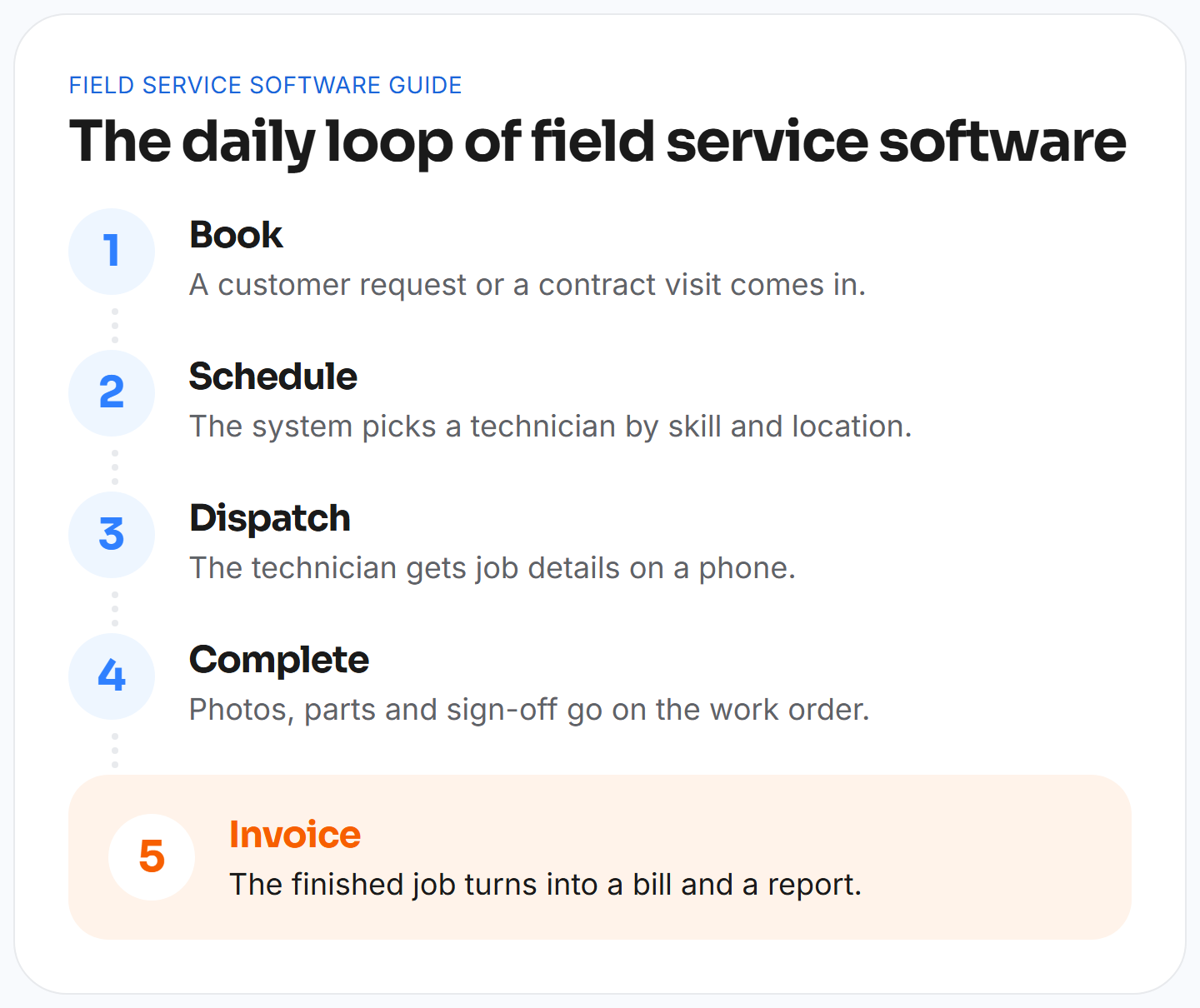 Intelligent scheduling picks the right technician at the right time. Technicians use the app to see job details, update status and handle data collection on site. Managers watch schedule changes and idle time live, so manual processes shrink, service operations run smoothly and teams spend less time on admin.
Why more field teams adopt the software
The field service industry keeps growing, though research firms disagree on the size.
- Global Market Insights estimates the market at USD 5.49 billion in 2025, rising to USD 23.61 billion by 2035 at a 16% CAGR (Global Market Insights).
- Verdantix values the software market at $5.9 billion in 2025 and forecasts $11.3 billion in 2031, with North America holding 37% of spend (Verdantix).
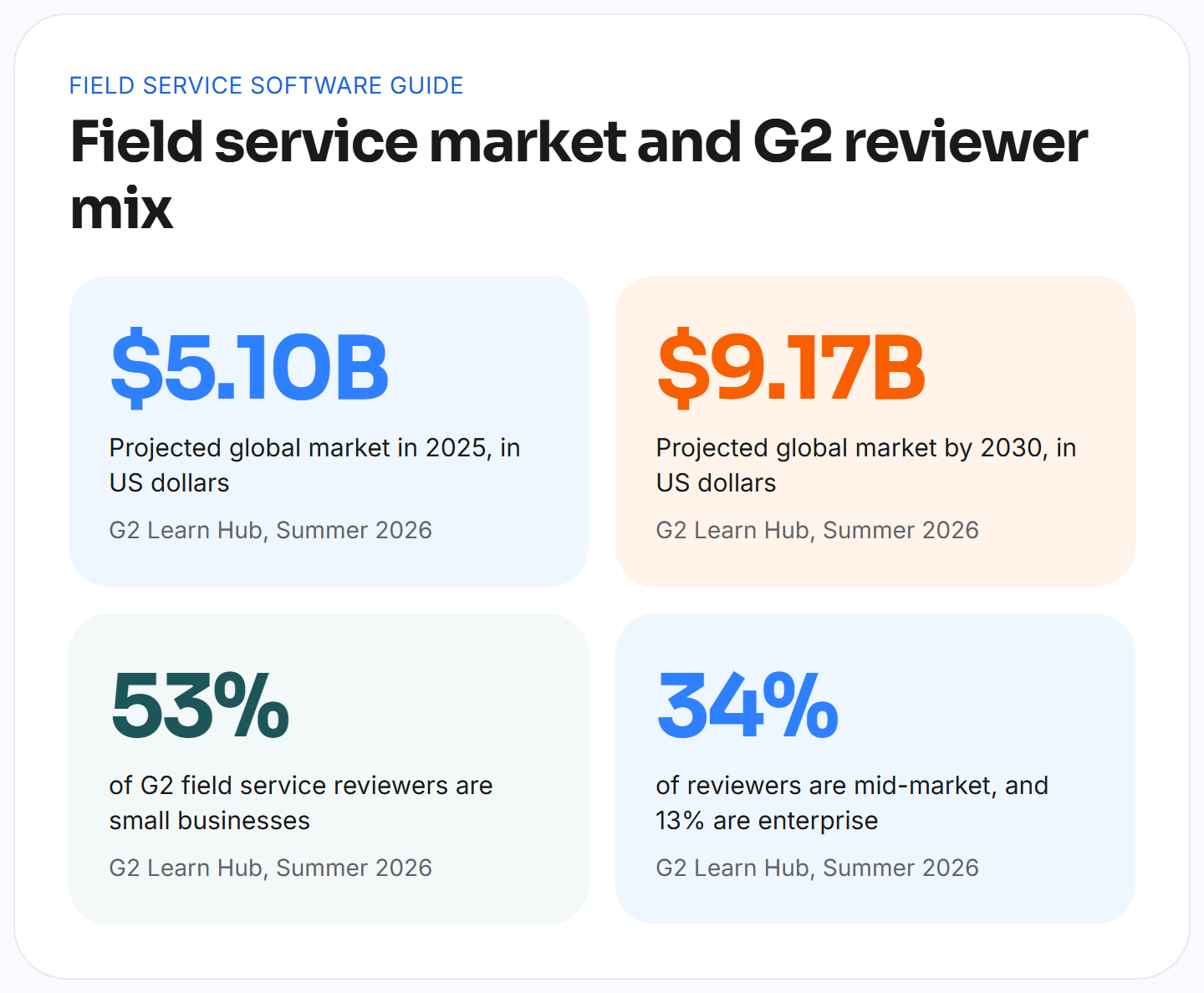
- G2's guide cites a lower range, from $5.10 billion in 2025 to $9.17 billion by 2030 (G2 Learn Hub, Summer 2026).
- In the US, IBISWorld reports that the field service software industry grew at a 7.7% CAGR between 2021 and 2026 (IBISWorld).
Who buys and why
 Buyers skew small, and small service businesses dominate the reviews. The same G2 page shows that small businesses make up 53% of reviewers, mid-market firms 34% and enterprises 13%. Leaders also see the value. Salesforce reports that 86% of decision makers at companies with field service teams believe those teams are critical to growing the business (Salesforce).
Benefits teams report
 Teams switch for practical reasons.
- Fewer missed visits. Shared schedules replace phone calls and whiteboards.
- Faster billing. Technicians close the job on site, so the invoice leaves the same day.
- Better experience. Customers get reminders and status messages, which improves customer experience and lifts customer satisfaction.
- Competitive edge. Faster response and cleaner records give you a competitive advantage and support business growth.
Who uses field service management software?
Any field service business benefits, and field service companies of every size use it, from one-van firms to multi-site contractors. Field operations differ, but the loop stays the same.
- HVAC firms. They schedule maintenance rounds and track every unit they maintain.
- Electrical contractors. They run quotes, jobs and invoices from one app. Autodesk's 2026 survey of 954 businesses across six Asia-Pacific markets found 60% of respondents using construction management cloud software (IT Brief).
- Fire and lift firms. They record compliance sign-offs for audits.
- Facility teams. They manage crews across several sites. P&S Intelligence expects the UAE facility management market to reach $36,575 million by 2030, with property services holding 28.1% of services (PR Newswire).
- Solar installers. They follow each install with scheduled maintenance visits.
Top field service management software at a glance
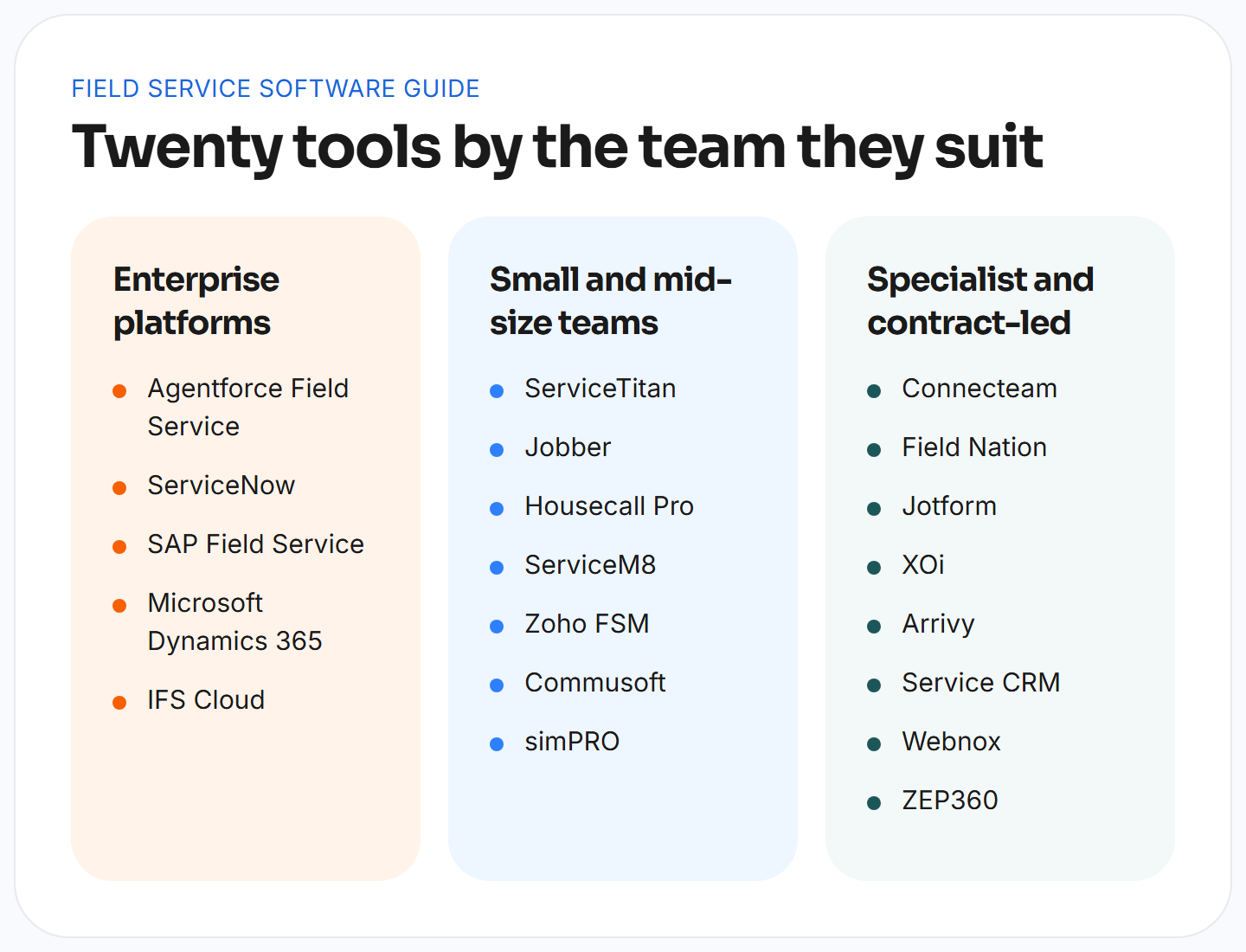
Looking for a list of the best field service management software available in 2027? Here are the 20 tools in this guide, grouped by the team they suit. Enterprise platforms integrate with CRM and ERP but need a technical setup. Small-team apps launch in days. Specialist tools solve one part of the job. Each tool gets a short profile in the next section.
| Software | Best for | Standout feature |
| Agentforce Field Service | Teams already on Salesforce | Scheduling inside Salesforce CRM |
| ServiceNow Field Service Management | Multi-location enterprises | Scheduling by skill and location |
| SAP Field Service Management | Companies running SAP ERP | Native SAP ERP integration |
| Microsoft Dynamics 365 Field Service | Microsoft-based businesses | Work orders tied to Dynamics 365 |
| IFS Cloud Field Service | Asset-heavy industrial firms | Embedded industrial AI scheduling |
| ServiceTitan | Mid-size and large trade firms | Scheduling, dispatch and invoicing in one platform |
| Jobber | Small businesses | On-site estimates and invoicing |
| Housecall Pro | Home trade teams | Automated client notifications |
| ServiceM8 | Small trade teams | Job-based app for iOS and Android |
| Zoho FSM | Businesses already using Zoho | Scheduling, work orders and billing |
| Commusoft | Commercial contractors with six or more staff | Software built for technical trades |
| Connecteam | Deskless teams | Scheduling, chat and time tracking in one app |
| Field Nation | Firms that need contract technicians | Nationwide technician network |
| Jotform | Teams that need digital forms | Drag-and-drop form builder |
| XOi | Teams that document jobs visually | Visual job-site records |
| Service CRM | Indian AMC firms | AMC and on-site quotation tools |
| ZEP360 | Project-led firms with maintenance contracts | Projects, stock and AMC in one record |
Three more tools deserve a look. simPRO targets trade and contracting businesses. Arrivy focuses on crew scheduling and customer communication. Webnox offers an Indian-built mobile app with live location tracking.
The best field service management software for 2027
The best field service management software available in 2027 includes Jobber and Housecall Pro for small teams, Agentforce, ServiceNow and SAP for enterprises, and ZEP360 for project-led firms with maintenance contracts. Every profile states who the tool suits and what reviewers say about it. The star ratings come from G2's Summer 2026 Grid. Check each vendor's own pages for current plans and limits.
Best enterprise field service software
Large firms with many sites usually pick from these five. They link deeply to CRM and ERP systems.
Agentforce Field Service for Salesforce teams
Agentforce Field Service (formerly Salesforce Field Service) suits teams that already run Salesforce. It assigns technicians by skill and availability, and it connects to Salesforce CRM so customer service agents and dispatchers share one record. G2 rates it 4.4. Reviewers say costs rise as you add features and advanced configuration takes technical time.
ServiceNow Field Service Management for large enterprises
ServiceNow schedules work dynamically by skill and location, and G2 reviewers say it scales cleanly across many locations. It rates 4.4. It fits large organisations that already use ServiceNow. Reviewers warn that setup needs technical expertise and carries a learning curve.
SAP Field Service Management for SAP ERP users
SAP's tool gives you real-time dispatch, scheduling and mobile access, with native integration to SAP ERP. That link matters if finance and inventory already live in SAP. G2 rates it 4.3. Reviewers describe a learning curve before it runs smoothly.
Microsoft Dynamics 365 Field Service for Microsoft shops
Dynamics 365 Field Service works best for companies that already use Microsoft's business apps. Work orders, customer data and scheduling sit inside the same ecosystem as Dynamics 365 and Microsoft 365. Check the setup effort with a partner before you commit.
IFS Cloud Field Service for asset-heavy firms
IFS Cloud Field Service targets industrial and asset-heavy businesses. IFS highlights embedded industrial artificial intelligence that supports real-time scheduling optimisation. It suits firms that maintain complex equipment and want planning and field work together. Expect a larger rollout than small-team tools need.
Best field service software for small and mid-size teams
These tools suit crews that want quick setup and a clean mobile app without enterprise complexity.
ServiceTitan for growing trade firms
ServiceTitan consolidates scheduling, dispatch and invoicing for trade businesses. G2 rates it 4.5. Reviewers like the end-to-end coverage. They also report a steep learning curve and a long setup, so plan for onboarding.
Jobber for small businesses
Jobber suits small businesses that want estimates, scheduling and invoicing in one app. G2 rates it 4.6. Reviewers praise on-site estimates and a reliable mobile app. They note that advanced features sit in higher tiers.
Housecall Pro for home trade teams
Housecall Pro serves home trade teams such as plumbers, electricians and HVAC crews. G2 rates it 4.3, and reviewers like easy scheduling, on-site invoicing and automated client notifications. Some say the mobile app can feel buggy.
ServiceM8 for small trade teams
ServiceM8 is a job-based app for small trade businesses, with iOS and Android versions that work almost the same. It handles recurring jobs and asset records. Firms that run projects with long timelines often outgrow that model. Our guide to job management software explains the difference.
Zoho FSM for Zoho users
Zoho FSM covers scheduling, dispatch, work orders, estimates and billing, and it connects to the wider Zoho suite. It suits businesses that already use Zoho CRM or Zoho Books. Teams outside that ecosystem should test the integrations first.
Commusoft for commercial contractors
Commusoft builds software for technical trades and commercial contractors. The vendor says its platform suits businesses with six or more staff, and it isn't available in every region yet. Confirm availability in your country before you book a demo.
Best specialist tools for field service teams
Some products solve one part of the job very well. Pair them with a core system or use them where that part hurts most.
Connecteam for deskless teams
Connecteam is a mobile-first app for deskless teams. It combines scheduling, communication tools and time tracking, and G2 gives it a 4.6 rating and its Easiest to Use label. Reviewers say reporting stays basic. It works best for workforce management where deep job costing isn't needed.
Field Nation for contract technicians
Field Nation gives you access to a nationwide network of independent technicians. G2 rates it 4.5. It helps with contractor management when you need coverage outside your usual area. Reviewers advise checking technician profiles and past jobs before assigning work.
Jotform for digital forms
Jotform is a form builder and not a full FSM system. Its drag-and-drop forms capture inspection and job data, then sync it to other tools. G2 rates it 4.7. Reviewers warn that free-plan submission caps surprise some users.
XOi for visual job records
XOi records job sites visually and shares updates with customers. G2 rates it 4.9, the highest of the top ten, and reviewers report few real drawbacks. Some ask for deeper integrations and faster media uploads.
Arrivy for crew scheduling
Arrivy focuses on crew scheduling, customer communication, faster invoicing and cleaner job records. It suits firms that send crews to homes or sites and want customers to see arrival updates.
Best field service software for India
Indian firms often manage AMC contracts, reminders and instalment payments. Two local tools target that pattern.
Service CRM for Indian AMC firms
Service CRM handles complaints, job assignment, AMC management, reminders and EMI tracking. Technicians capture photos and signatures in a mobile app and raise a quotation or invoice on site. It suits repair centres and equipment dealers.
Webnox for Indian field teams
Webnox offers a mobile app with scheduling, live location tracking, expenses and claims, leave and attendance, and inventory. It suits Indian teams that want workforce admin and job tracking in one app.
ZEP360 for project-led firms with maintenance contracts
ZEP360 is our product, so weigh this profile accordingly. We built it for firms that win projects and then maintain them under annual maintenance contracts. Think HVAC, fire safety, electrical and facility maintenance. Our field service page lists every module.
- Skill-based dispatch. The system matches tickets to the nearest qualified technician.
- SLA timers. Response and resolution clocks run in real time and warn you before a breach.
- AMC renewals. Alerts go out before a contract lapses, so renewals don't depend on memory.
- Spare parts. Technicians scan parts out of van stock, so inventory and job costs stay accurate.
- Customer sign-off. The customer signs on the technician's phone, and a client portal shows visit status.
ZEP360 isn't the right pick for a solo operator who only needs quoting and invoicing. A simple app like Jobber covers that. It fits best when a project hands over into long-term maintenance.
How real users rate the top tools
G2's Summer 2026 Grid ranks tools from verified reviews. The scores sit close together, so fit matters more than rank.
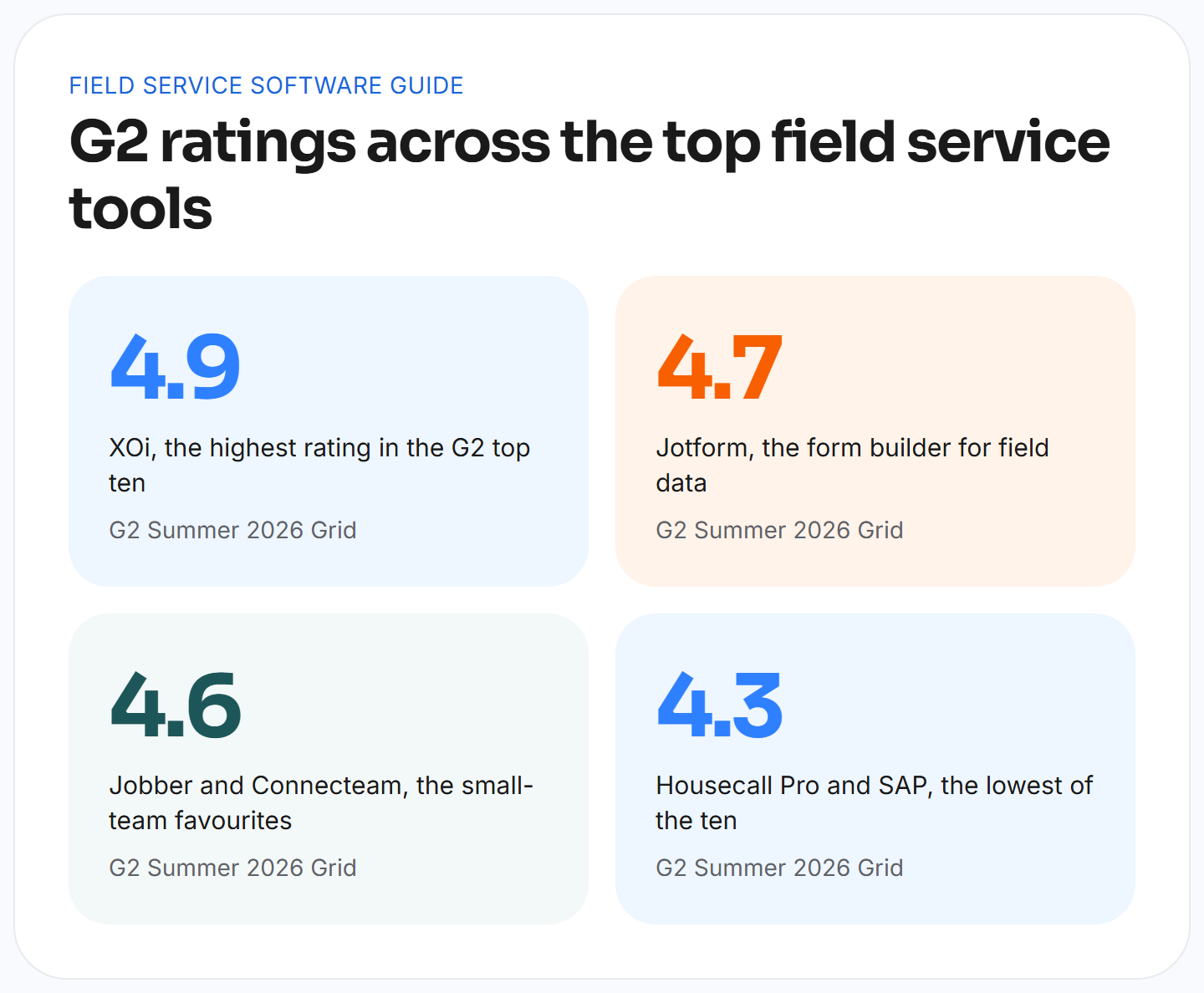
- Ease of use. Connecteam earns G2's Easiest to Use label, and Jobber and Jotform score highest among the broader tools.
- Depth. ServiceNow, SAP and Agentforce score lower but handle larger operations, and reviewers trade ease of use for that depth.
- Learning curve. Reviewers flag a learning curve on ServiceTitan, ServiceNow and SAP.
Key features to check before you shortlist
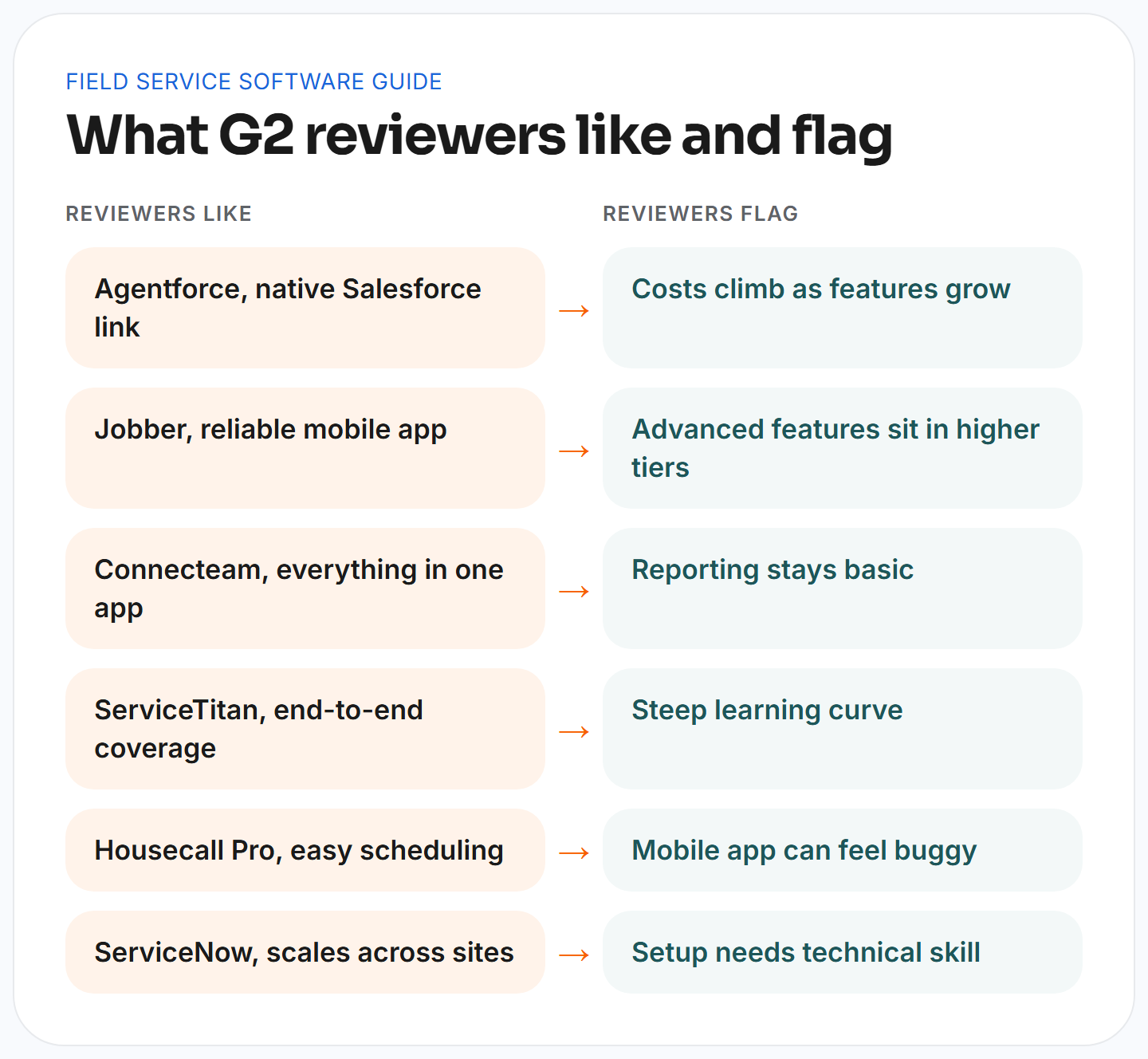 Vendors list dozens of software features. These nine key features decide whether a tool fits daily work.
Features for dispatch and field work
- Smart dispatch. Look for assignment by skill and location, plus a view of which field staff are free right now.
- Work orders. Check for photos, parts, notes and sign-off on every visit. Our work order format guide and free work order template show what a complete record holds.
- Mobile app. Ask your field service technicians to try it. Ease of use decides adoption.
Features for customers and parts
- Customer portal. Customers should book, track and approve without phoning customer support.
- Inventory. Van and warehouse stock should update as parts are used. Our glossary covers inventory management.
- SLA tracking. If you promise response times, the system should track a service level agreement and alert before a breach.
Features for planning and reporting
- Maintenance. Recurring tasks matter if you sell contracts. See how preventive maintenance and an annual maintenance contract fit the system.
- Reporting. You need job profitability, technician utilization and repeat-visit rates, and not only job counts.
- Integrations. Check links to accounting, ERP and CRM so data moves without re-typing.
Maintenance planning pays off in numbers.
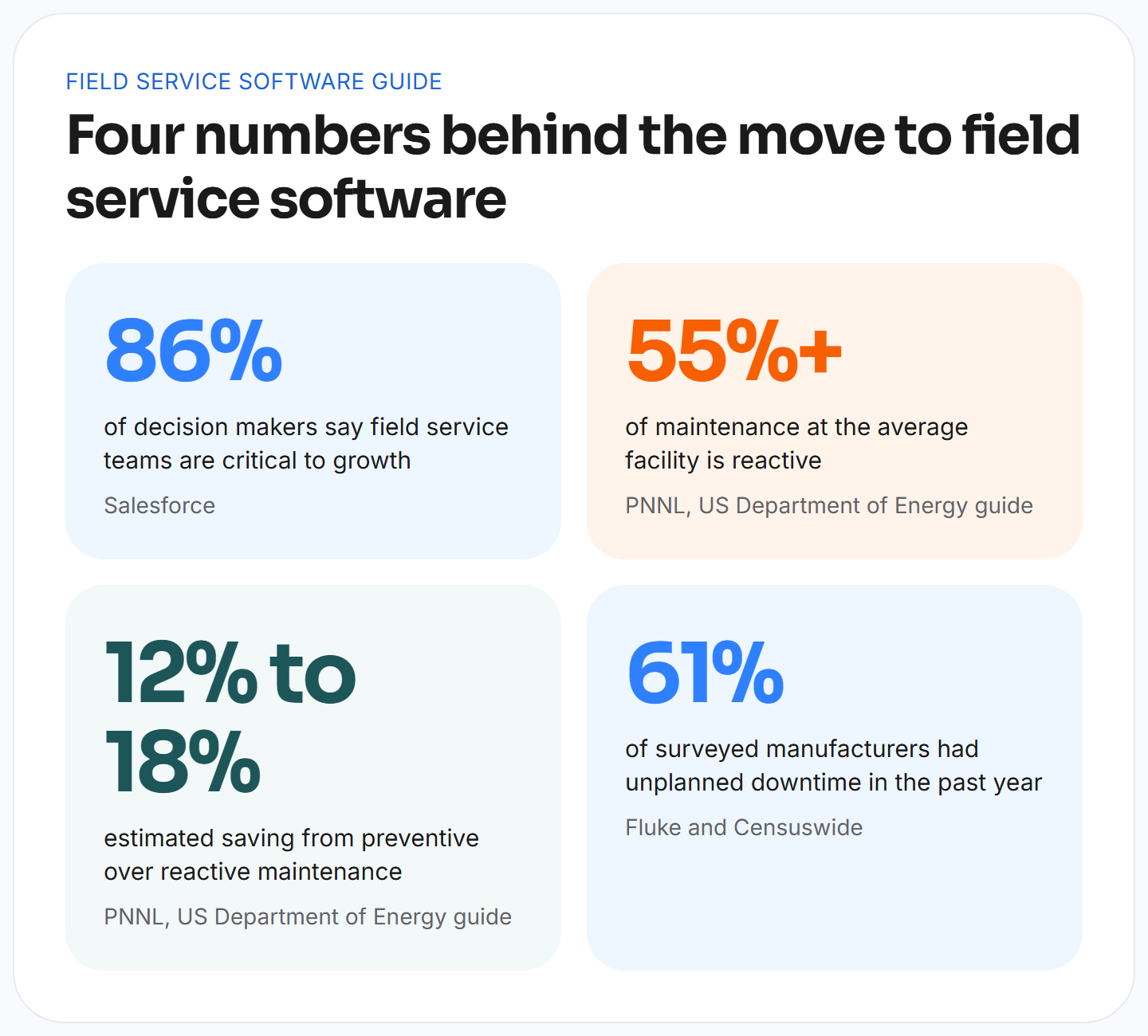
A US Department of Energy guide from PNNL reports that over 55% of maintenance at the average facility is reactive, and that preventive programs save an estimated 12% to 18% over reactive ones (PNNL).
A Fluke survey found 61% of manufacturers suffered unplanned downtime in the past year (Fluke). Artificial intelligence now adds predictive maintenance, faster scheduling and remote assistance, so test it on your own jobs before it drives the decision.
Asset service management and predictive maintenance
Teams that maintain equipment need more than a job list. Asset records store each unit's serial number, warranty and past repairs, so a technician sees the history before arriving. Preventive schedules then raise visits on their own.
Predictive maintenance goes a step further. It uses sensor or usage data to flag a unit before it fails, which suits chillers, lifts and generators. Few small-team apps offer it, so check that a tool supports the assets you actually service.
Remote assistance and customer communication
Some visits don't need a truck. Remote assistance lets an expert see what the technician sees through a phone camera and guide the repair. Salesforce lists a visual remote assistant for this, and other enterprise tools offer similar features.
Customer communication matters just as much. Look for automatic reminders, arrival updates and a portal where customers approve quotes and sign off work. Those messages cut inbound calls and lift customer satisfaction.
Using analytics to find inefficiencies
Reports only help when you act on them. Start with repeat visits, which point to training or parts gaps. Then check travel time for poor routing, idle time for scheduling slack and job margin to see which contracts lose money. Review the numbers weekly for a month, then fix the biggest leak first.
Field service software and building management systems
Facility teams often ask which software works with a building management system (BMS). A BMS controls building equipment such as HVAC, lighting and access. Field service software does a different job. It schedules and records the people who maintain that equipment.
The two work best together. When they're integrated, a BMS alarm can raise a work order, and the technician's visit history then sits against the asset. Ask vendors whether they integrate with your BMS or CMMS.
How to choose the right field service management software
Start with your work, not the vendor's feature list. These five steps build a shortlist in about two weeks.
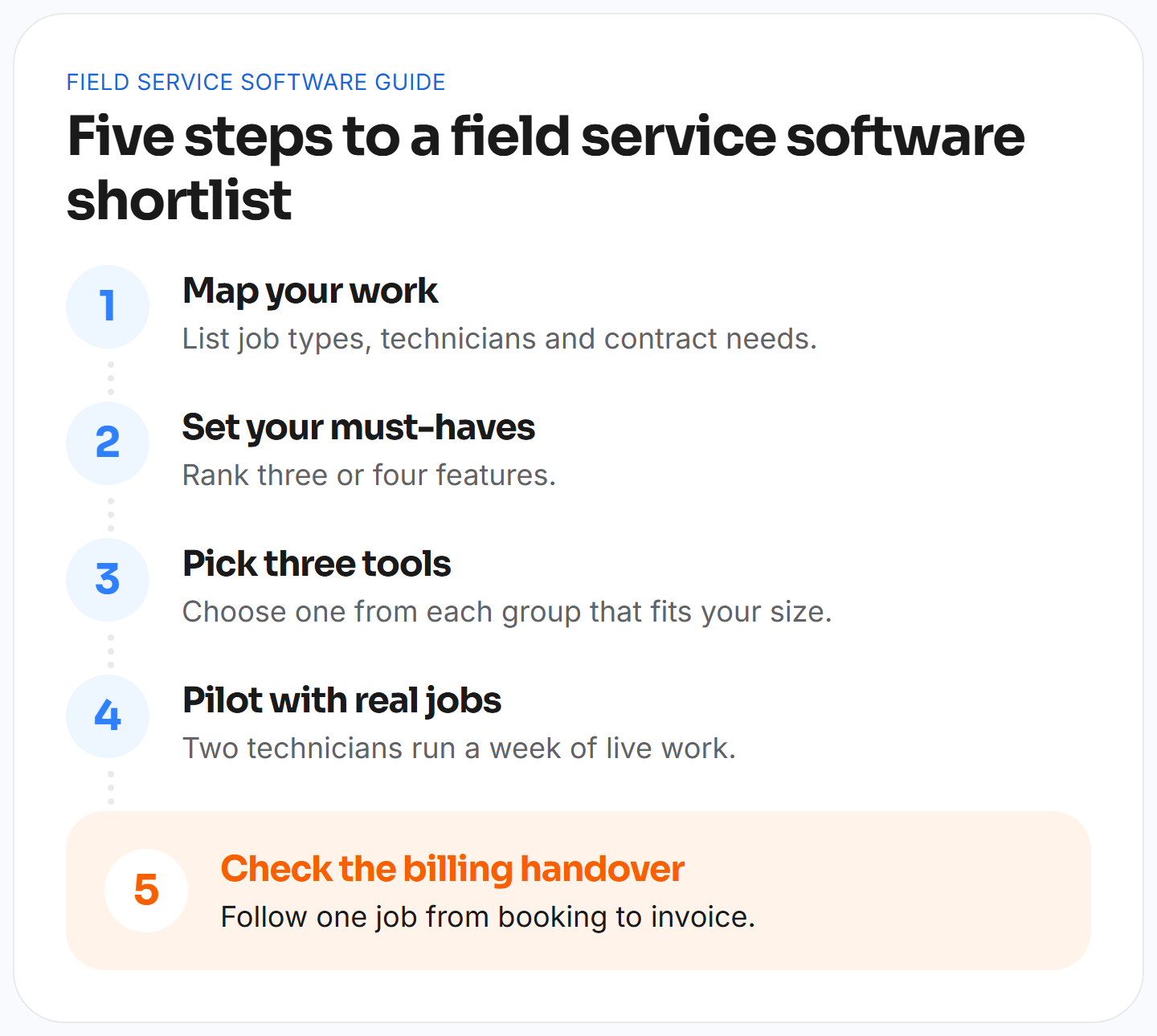
- Map work. List the job types you run, how many technicians you have and whether you sell contracts.
- Set must-haves. Pick three or four features from the list above and rank them.
- Pick three. Use the table to choose one tool from each group that fits your size.
- Pilot. Ask two technicians to run a week of live jobs and report what slowed them down.
- Check billing. Follow one job from booking to invoice and look for re-typing.
Our guide on how to choose field service software goes deeper on contract and SLA checks and on a 30-day trial plan.
Free FSM software options
Some vendors offer a free plan or trial, which lets team members test the right tools on real jobs. Free plans cap users, jobs or submissions, so treat them as a trial and not a long-term setup.
Common mistakes to avoid
Firms buy an enterprise platform when a small tool would do. They skip the technician trial. And they ignore how projects hand over into maintenance, which is where records often get lost. Plan the rollout too. Technicians who aren't comfortable with apps adopt a tool faster after a short walk-through of the three screens they use every day.
Final thoughts
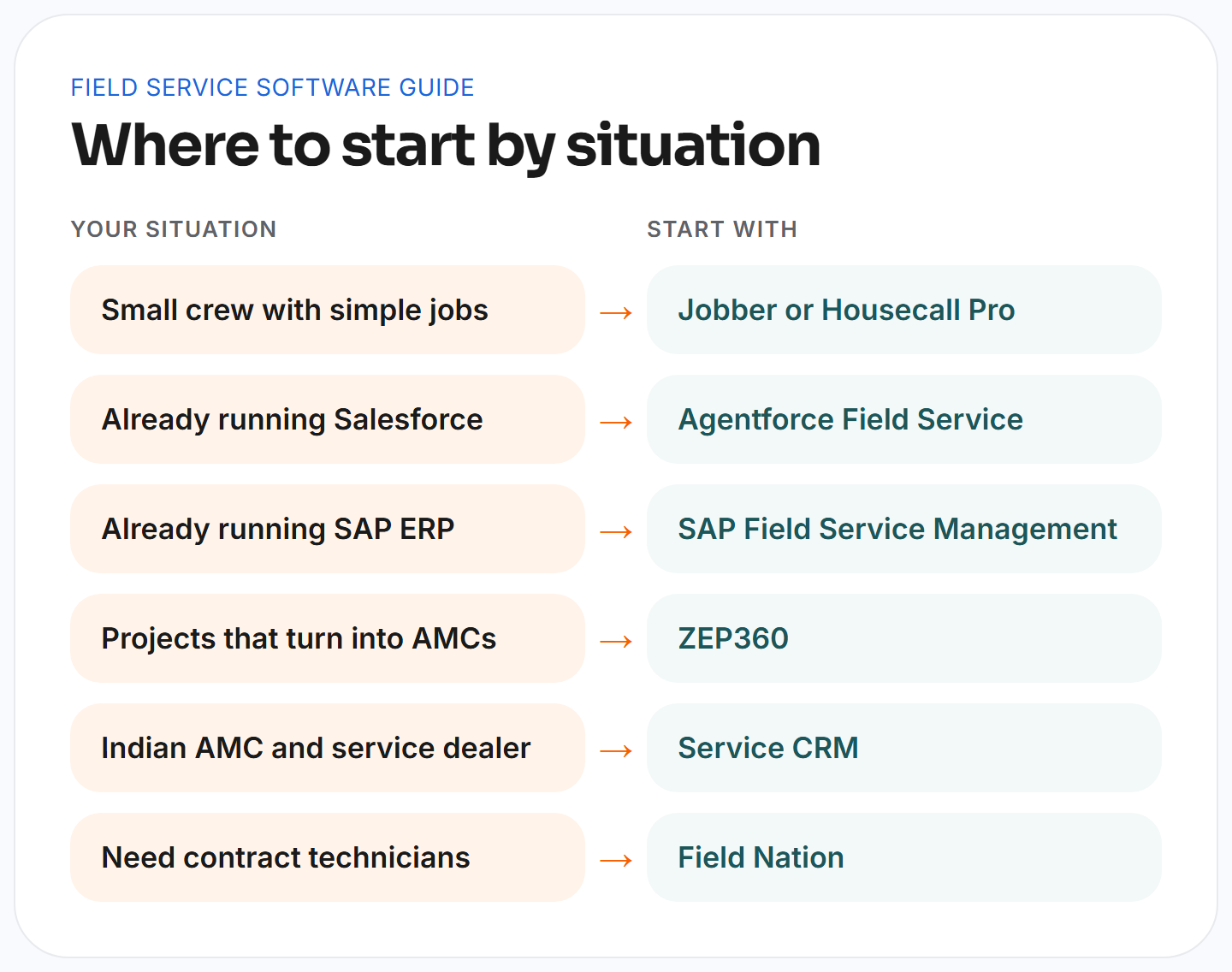 The right tool matches your team size and your contract model. Small crews do well with Jobber, Housecall Pro or ServiceM8, large organisations lean toward Agentforce, ServiceNow or SAP, and project-led firms with AMCs need projects and maintenance in one record. Shortlist three tools, trial them on real jobs and pick the one your technicians actually use.
If you run projects that turn into maintenance contracts, talk to the ZEP360 team about how ZEP360 would map to your work.
Frequently asked questions
What is the difference between CRM and field service management software?
A CRM manages leads, quotes and customer relationships up to the sale. FSM software handles delivery after it, including scheduling, dispatch, work orders and invoicing. Many platforms bundle both so customer data flows into jobs without re-entry.
Is there free field service management software worth trying?
Yes, some FSM tools offer a free plan or trial. Connecteam lists a free trial and Jotform has a free plan. Free plans cap submissions, users or jobs, so test them with real work first.
What is the best field service management software for small businesses?
For small teams, Jobber, Housecall Pro, ServiceM8 and Connecteam stand out in G2 reviews for quick setup and easy mobile apps. The best fit for you depends on whether you sell single visits or ongoing contracts.
Is there field service management software designed for businesses in India?
Yes, Service CRM and Webnox build FSM software for Indian firms, with AMC tracking, reminders and live location. ZEP360 also serves Indian project and maintenance firms. Check local support and regional tax features before you choose.
How do I compare field service management software to choose the right one?
Start with your job types, team size and contract needs. Shortlist three tools, then run a week of live jobs with two technicians. Compare scheduling, mobile use, inventory, reporting and integrations side by side before you decide.
What are the benefits of field service management software?
FSM software reduces missed visits, speeds up invoicing and keeps full service history in one place. Customers get status updates without calling, and managers see technician workload, repeat visits and job profitability in real time.
What features should field service management software have?
A good platform should have scheduling and dispatch, work orders, a mobile app, inventory, SLA tracking and reporting. Add a customer portal and integrations with accounting or ERP if you run contracts or large teams.
How does field service management software help optimize operations?
FSM software optimizes operations by assigning the right technician to each job, cutting travel and idle time, and recording work on site. Managers then spot slow jobs, repeat visits and stock gaps before they hurt margins.
Get complete visibility of every project site.
Switch to ZEP360 and discover a unified way to manage your business.
Book a Demo- Field Service Management


