

Get complete visibility of every project site.
Switch to ZEP360 and discover a unified way to manage your business.
Book a Demo
The best EPC software depends on what your firm builds and how big it is. A solar installer running 20 sites needs a different tool than a transmission contractor with hundreds of crews. This guide lists 21 top tools for 2027 and shows who each one suits.
This guide to the best EPC software covers what EPC software does, the features that matter, a table of all 21 tools and short profiles grouped by type. We also build EPC software, so we flag where ZEP360 fits and where it doesn't. We don't compare prices here, because vendors change them often and most quote after a demo.
What is EPC software?
EPC software is a business system for EPC companies. These are firms that take responsibility for engineering, procurement and construction under one EPC contract. The software tracks the money, materials, people and project progress across the entire project lifecycle in one place. Buyers in the EPC industry search for EPC project management software, an ERP system, or a mix of both.
This work is harder to manage than ordinary construction because three phases run at once. A design change in the engineering phase alters a purchase order, and the purchase order alters the construction phase schedule. A tool that sees only one phase leaves project managers and finance teams working from different numbers.
Most of the best EPC software falls into three families. The next section explains each one, so you can tell what a vendor really sells.
Three types of EPC software
Vendors use the term EPC software for very different products. Knowing which type you need saves you from comparing tools that do different jobs.
- Engineering design software: It produces drawings, 3D models and engineering data. Large engineering teams on complex projects need it.
- Project controls software: This is project management software for large builds. It plans schedules, tracks cost against budget and manages risk on complex projects and industrial projects.
- EPC ERP software: It joins sales, projects, purchasing, stock, subcontractors and finance in one record. It suits EPC contractors that need a single source of truth from tender to handover, on a unified platform.
Small and mid-size firms usually start with the third type. Our guide on job management software explains how a connected system carries a job from quote to service.
Why EPC firms need software
Large projects rarely finish on time or on budget. McKinsey research from 2015 estimates that 98% of megaprojects suffer cost overruns of more than 30%, and 77% run at least 40% late (McKinsey, 2015).
Infrastructure development is driving the workload in India, and it keeps rising. The Union Budget 2026-27 raised public capital expenditure to ?12.2 lakh crore from ?11.2 lakh crore (PIB budget summary, 1 February 2026). GlobalData expects Indian construction output to pass $1 trillion in 2027 (GlobalData via NBMCW, April 2026).
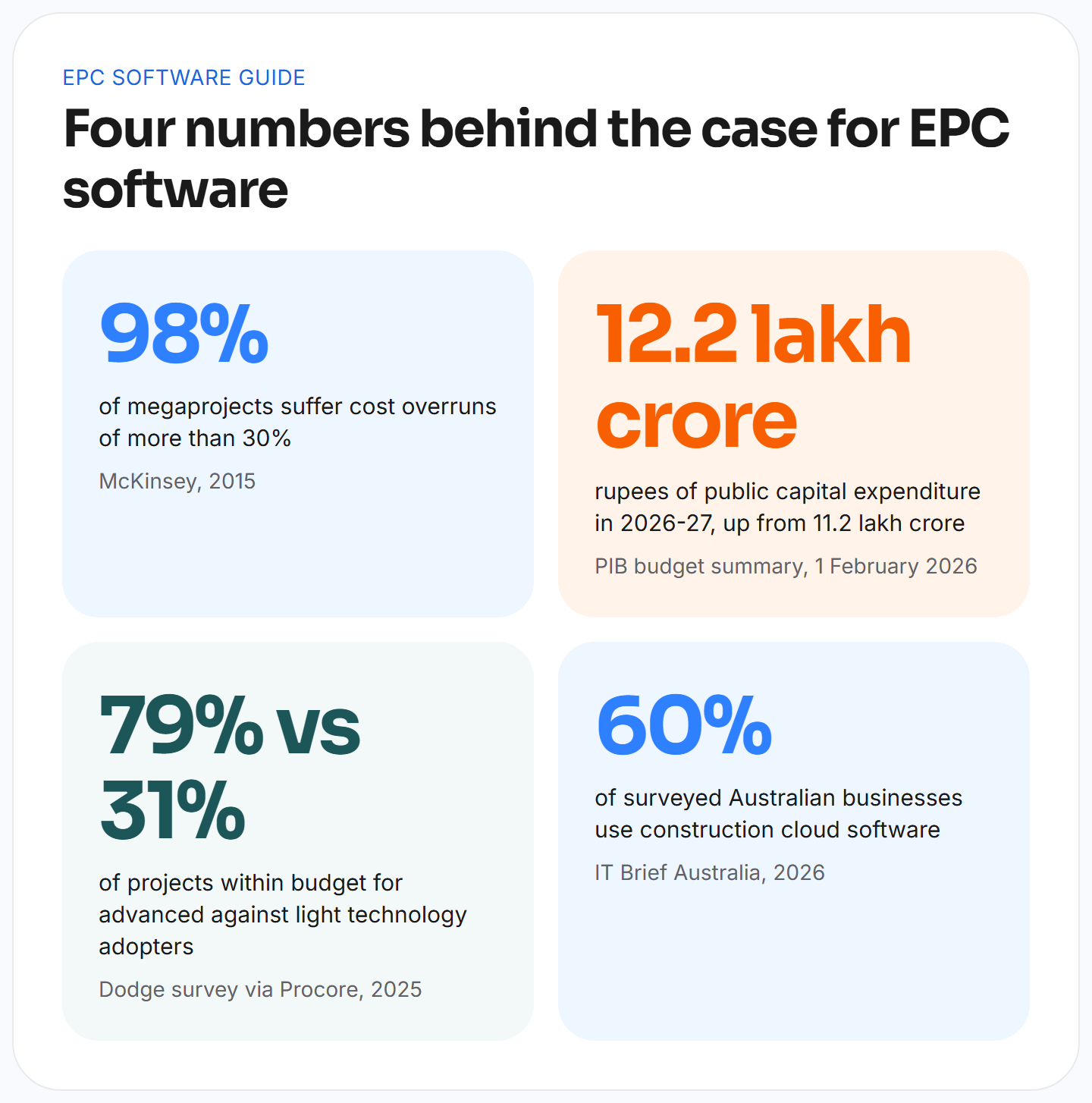 Technology use also tracks results. A Dodge Construction Network survey of more than 1,500 professionals found that 79% of projects came in within budget for the most advanced technology adopters, against 31% for light adopters (Procore's summary of the Dodge survey, 2025). Procore sponsored the survey, so treat it as a direction and not a guarantee. In Australia, an Autodesk survey of 954 businesses found that 60% already use construction management cloud software (IT Brief Australia, 2026).
More work means more chances for EPC companies to hit the same five problems.
- Purchase orders miss the BOQ: Site engineers buy from memory, so costs and delivery schedules drift. A connected system raises each order against the approved quantities.
- Subcontractor bills wait on measurement: Disputes delay payment. Progress records that feed the bill cut the argument.
- Site progress arrives late: Project managers hear about delays after the fact. Daily updates from a phone show them while there's still time.
- Budget and actual costs sit apart: The loss shows up at month end. A shared record shows it as it happens.
- Handover files get lost: After-sales teams start from scratch. One record carries the project into service.
Key features of the best EPC software
A long feature list rarely separates good products from poor ones. Vendors list a wide range of features.
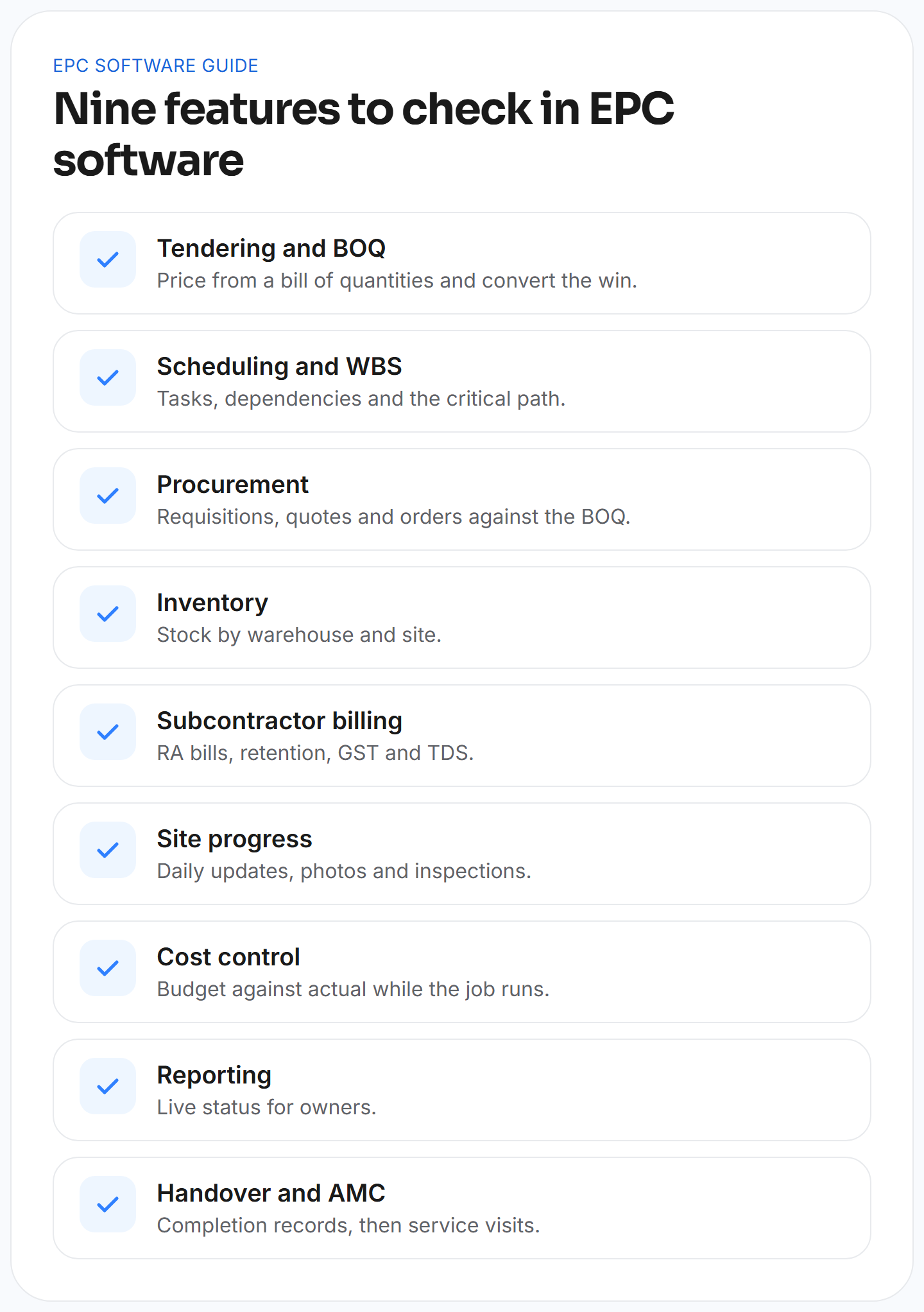 These nine decide whether a tool is the best EPC software for your business, and each one should work end to end in a demo.
- Tendering and estimating: Capture each tender, price it from a bill of quantities and a bill of materials, and convert the winning bid into a project without retyping.
- Scheduling and work breakdown structure: Break each project into tasks, set dependencies and watch the critical path. Large construction projects need a multi-level work breakdown structure and clear resource allocation for crews.
- Procurement and vendor management: Raise requisitions, compare quotes and issue purchase orders against the BOQ. Our guide to purchase order software goes deeper.
- Inventory and site material: Show stock by warehouse and site, so a crew never waits for raw materials that sit idle elsewhere.
- Subcontractor management and billing: Track work orders, running account bills, retention and deductions. Look for GST compliance and TDS handling that match Indian rules.
- Site progress and quality inspections: Site engineers should log daily progress, photos and quality inspections from a phone. A failed check should trigger corrective action.
- Cost control and finance: Compare project budgets with actual costs, and keep committed spend visible. Strong job costing shows profit while the project runs.
- Reporting and dashboards: Owners should see status in real time for every project without asking project managers.
- Handover and after-sales: A good tool tracks the completion certificate and then schedules service visits under an annual maintenance contract, with asset management for the equipment you installed.
The best EPC software at a glance
The best EPC software list below has 21 tools. They come from the top-ranking pages for this keyword and from each vendor's own site. We read the vendors' public pages in November 2026. Where a page says something we couldn't check, we write that the vendor "says" it. A missing feature means we didn't find it on public pages, not that the tool lacks it.
| Tool | Type | Best suited to |
| ZEP360 | EPC ERP | Small and mid-size EPC, MEP and solar firms |
| Realx ERP | EPC ERP | Indian EPC and infrastructure contractors |
| StrategicERP | EPC ERP | Indian construction and infrastructure firms |
| OctaBees | EPC ERP | Solar and renewable EPCs |
| Lighthouse ERP | EPC ERP | Transmission and infrastructure contractors |
| ERPNext | Open-source ERP | Firms with in-house or partner IT skills |
| Odoo | Modular ERP | Firms that want to configure their own setup |
| Microsoft Dynamics 365 | Global ERP | Firms already on Microsoft tools |
| SAP S/4HANA Cloud | Global ERP | Large enterprises |
| Oracle NetSuite | Global ERP | Growing contractors that want one cloud suite |
| JD Edwards EnterpriseOne | Global ERP | Firms with Oracle systems |
| Infor CloudSuite E&C | Global ERP | Engineering and construction groups |
| AVEVA | Engineering design | Engineering teams on complex capital projects |
| Oracle Primavera Cloud | Project controls | Schedulers on large projects |
| Procore | Construction management | Main contractors and subcontractors |
| InEight | Project controls | Owners and EPCs on the largest projects |
| Sitetracker | Rollout management | Telecom, renewables and EV charging programs |
| Bentley SYNCHRO | 4D planning | Teams that sequence work against a 3D model |
| Octave Sequence Enterprise | Project controls | Owners and EPCs with large portfolios |
| Cleopatra Enterprise | Project controls | EPCs in oil, gas, power and renewables |
| O3 Solutions | Work packaging | EPCs that use advanced work packaging |
EPC ERP software for Indian contractors
These tools are among the best EPC software for firms that want sales, projects, stock and finance in one system. We list ZEP360 first because we make it.
ZEP360 is EPC business management software for small and mid-size EPC, MEP and solar firms in India, Australia, New Zealand and the UAE. It brings comprehensive project management together with finance. It joins tenders, BOQs, projects, stock, running bills and finance, then carries the customer into AMC after handover. It doesn't do engineering design. A fuller profile follows below.
Realx ERP is a cloud platform from Snaps Technologies for real estate, construction, infrastructure and EPC firms. Its pages describe BOQ upload with version history, RA bills generated from site progress, retention, daily progress reports and GST and TDS calculation on bills. We found no scheduling feature on its BOQ page.
StrategicERP, from Mumbai-based ITAakash Strategic Software, targets real estate, construction, infrastructure and EPC firms. It lists a multi-level work breakdown structure, MS Project import, Gantt charts and earned value management. It names Indian infrastructure customers such as Capacite Infraprojects. Its pages mention GST only for work orders and purchase orders, so ask for detail.
OctaBees, from Vadodara, builds a cloud ERP with the strongest solar and renewable focus on this list. It lists tender management, BOQ costing, daily progress reports with geo-tagged photos and statutory approval tracking such as net metering. Its pages show no dedicated subcontractor billing, and it says its own team handles integrations.
Lighthouse ERP is a general ERP whose main site leans toward manufacturing. Its power transmission page lists project cost dashboards, site-wise inventory, a contractor module for work orders and RA bills, and GST reports. It suits transmission and infrastructure contractors that want a long-established ERP vendor.
ERPNext, from Frappe, is open-source ERP software. Its EPC page lists project cost against estimates, budgets that warn or block overspend, project-site warehouses and subcontractor tracking. It doesn't list tendering, BOQ or RA billing, and Frappe says complex setups need a partner.
Odoo is a modular open-source suite. Its construction page covers estimating, progress billing, change-order tracking and mobile timesheets, and its documentation covers India e-invoicing, e-way bills and GST returns. The construction page doesn't list BOQ or subcontractor management, so expect to configure those.
Global ERP suites
Global suites offer broad finance and project accounting. They fit larger firms, or firms with an implementation partner, and Indian GST support often needs a check.
Microsoft Dynamics 365 offers Business Central for small and mid-size firms and Project Operations for project-based firms. Business Central lists job costing, resource planning and subcontractor cost tracking, and Microsoft says 55,000 companies use it. Its pages make no India or GST claim, so confirm local compliance with a partner.
SAP S/4HANA Cloud covers project financials, digital procurement and milestone billing for construction. SAP's learning page also lists mobile access for field teams and real-time budget variance reports. We couldn't confirm work breakdown structure support or Indian GST handling from public pages.
Oracle NetSuite pitches a cloud ERP for construction and specialty contractors. Its page lists job costing, WIP accounting, retainage, change-order workflows, inventory and field service in one suite. NetSuite notes that some capabilities need partner integrations. We found no India-specific claim on that page.
JD Edwards EnterpriseOne has four project modules in its release 9.2 documentation. They are Project Costing, Contract and Service Billing, Change Management and Homebuilder. Project Costing shows budget, current cost, open commitments and percent complete. We couldn't read Oracle's marketing pages, so confirm fit and India support with a partner.
Infor CloudSuite Engineering and Construction runs on Infor LN and names EPC contractors among its audiences. It lists project and contract management, procurement, a collaboration portal for subcontractors and suppliers, and engineer-to-order support. Infor says it runs as multi-tenant SaaS. We found no India or GST content.
Project controls and engineering platforms
These tools go deep on one job, such as scheduling, engineering data or work packaging. Firms often run them beside an ERP.
AVEVA targets engineering and design on complex capital projects. Unified Engineering links 1D, 2D and 3D data and P&IDs, and Enterprise Resource Management covers requisitions, supplier selection and materials tracking. AVEVA says its materials tool can connect to ERP and scheduling systems.
Oracle Primavera Cloud is Oracle's scheduling platform. Its page lists critical path scheduling, pull planning for field teams, resource management and risk analysis with Monte Carlo simulation. The page doesn't list accounts, purchasing or stock, so firms usually pair it with an ERP.
Procore is a cloud platform for main contractors, owners and subcontractors. It lists cost management, change orders from the field, look-ahead scheduling, daily logs and offline mobile apps. Its pages show sites in Singapore, Australia, New Zealand and the UAE but no India mention, and we saw no dedicated procurement feature.
InEight is a capital project platform for owners, EPCs and design-builders on the largest, most complex projects. It lists scheduling, estimating, contracts and payments, change orders and document management. Its home page doesn't mention procurement or India.
Sitetracker targets rollout programs such as telecom, renewables and EV charging. It lists project, financial, agreement and field work management on one cloud platform. It fits repeatable deployments more than engineering-heavy EPC work, which is our own reading of its segments.
Bentley SYNCHRO links a construction schedule to a 3D model for 4D sequencing and what-if planning. Bentley says it works with Primavera P6 and Asta Powerproject schedules. It needs heavy hardware and isn't a finance or procurement tool.
Octave Sequence Enterprise, formerly EcoSys, suits owners and EPCs managing large portfolios. It lists earned value, budgeting and forecasting, change orders, field reporting and ERP integration on a multi-tenant cloud. Octave listed document management as coming in Summer 2026, so check whether it's live.
Cleopatra Enterprise serves owners, EPC contractors and engineering firms in oil and gas, renewables and power. It lists cost estimating, scheduling, risk, change management and material management. It says more than 500 organizations trust it. We couldn't read its capital projects page.
O3 Solutions offers ONPlan, ONBuild, ONTrack and ONComplete for advanced work packaging, digital work management and turnover. It says it covers small projects through gigaprojects. Its home page lists no cost control or procurement modules.
How to choose the best EPC software
Choosing the right ERP or project tool starts with your size and the unique needs of EPC companies like yours. The best ERP for a ten-person firm isn't the best ERP for a listed contractor.
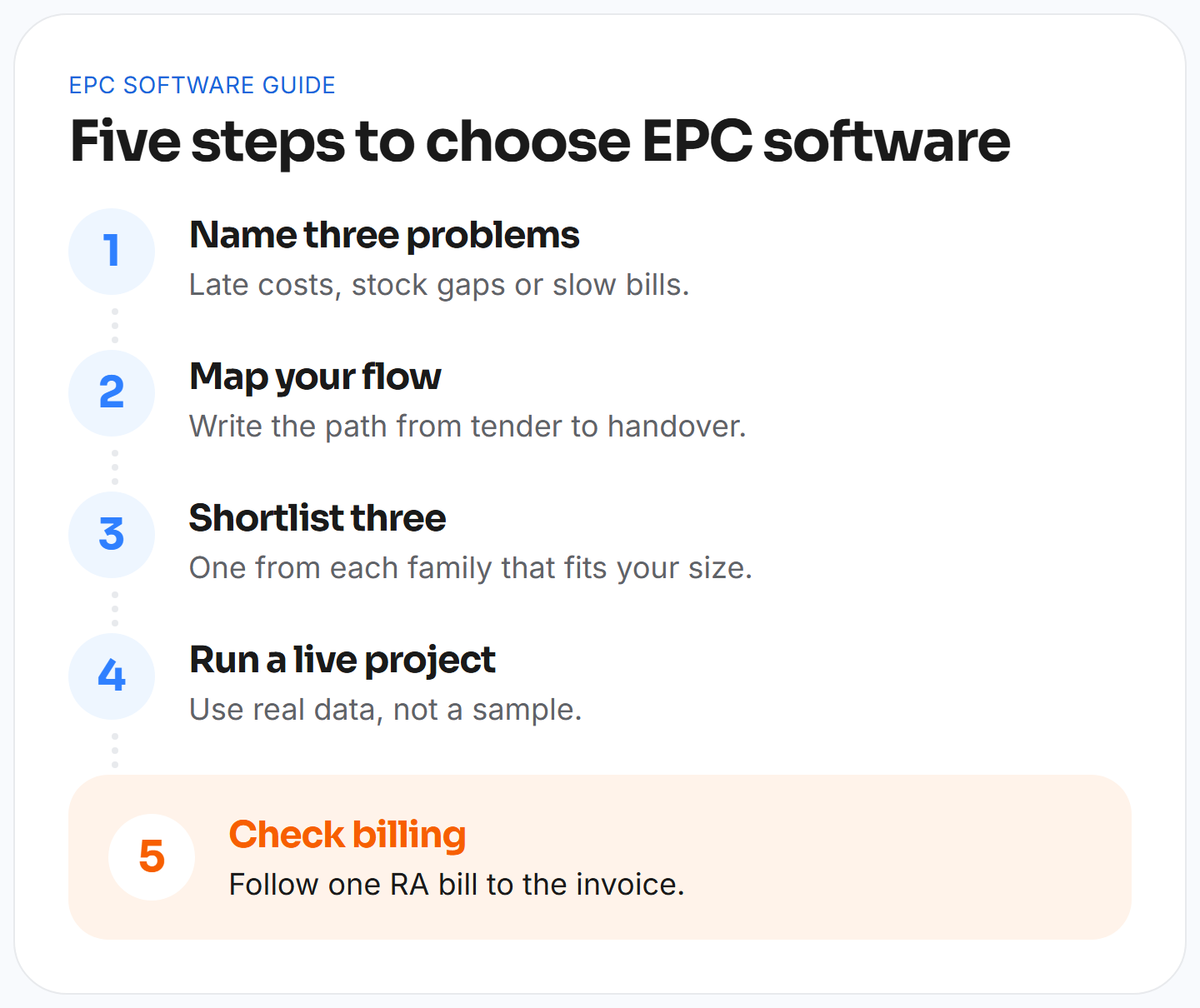 Test each shortlisted tool against one of your own projects, and use these five steps.
- Name three problems: Late costs, missing stock visibility and slow subcontractor bills are common starting points.
- Map your project flow: Write the path from tender to handover, including approvals.
- Shortlist three tools: Pick one from each family that fits your size.
- Run one live project: Use real data, not a sample.
- Check the handover to billing: Follow one RA bill from site progress to the invoice.
Ask every vendor the same questions during the demo.
- What happens when a tender is won? The scope, BOQ and client details should become the project automatically.
- How do site requests reach the store? Ask to see one raised on a phone and received by a storekeeper.
- How are costs recorded? Spend should post to the project as it happens, not at month end.
- How does it handle GST? Ask for a live RA bill with GST and TDS applied.
- Who sets it up? Ask whether you need a partner and how long the rollout takes.
- What can you export if you leave? Your project data should leave with you.
Rolling out everything at once overloads site teams. Start with sales and projects, add stock and procurement next, and connect finance last. Add new projects to the system first, and move old ones only at the right time.
Where ZEP360 fits
ZEP360 was built for EPC practitioners who run projects and then keep the customer on a service contract. It runs on one platform, so each handoff keeps the same record.
A tender or enquiry starts in ZEP Sales. When the deal closes, it becomes a project in ZEP Projects with the client details, site survey, BOQ and signed quote attached. Teams track site progress, running bills and change orders there, and budgets show spend as expenses are logged.
Material control sits in ZEP Inventory. Site material requests start inside the project and reach the right warehouse with the project number attached. Solar firms can see the same flow on our solar page.
After handover, ZEP360 field service schedules AMC visits against the same project history. Our roundup of top field service management software compares the wider market. ZEP Copilot answers questions about your data. It answers questions only and doesn't take actions for you.
ZEP360 doesn't draw engineering designs or 3D models. Teams keep their design tool and store the files on the project card. If you run EPC projects and annual maintenance contracts together, book a ZEP360 demo and bring one live project.
The best EPC software depends on your size, your project types and your after-sales plans. Run one live project through two tools before you sign. The best EPC software is the one your site teams will use every day. If you want a second opinion on your shortlist, our team will map it with you.
Frequently asked questions
What is the best EPC software for small firms?
The best EPC software for a small firm is an EPC ERP that joins tenders, BOQs, procurement, site progress and billing in one system. Heavy enterprise suites add setup time. ZEP360, Realx ERP and OctaBees target this size.
What is EPC software?
EPC software is a business system that tracks engineering, procurement and construction work in one place. It covers estimates, purchase orders, stock, subcontractor bills, site progress and project costs. Some EPC software focuses on engineering design or scheduling instead.
What features should the best EPC software have?
The best EPC software should handle tendering with BOQ, scheduling, procurement, inventory, subcontractor billing, site progress, cost control, reporting and AMC after handover. Check that each feature works end to end in a demo on your own project.
How is EPC software different from ERP?
EPC software is a broad term, and ERP is one type of it. An EPC ERP joins finance, purchasing, stock and projects in one record. Other EPC software, such as scheduling or design tools, handles one job.
Which EPC software suits solar firms?
The best EPC software for solar firms covers surveys, BOQs, material requests, net metering tracking and AMC. OctaBees and ZEP360 target solar work, and Sitetracker covers renewable rollouts. Our OpenSolar alternatives guide covers design tools.
Does EPC software integrate with my ERP?
Many tools do. Octave and AVEVA state ERP integration, and StrategicERP lists Tally integration. Ask each vendor which systems it connects to, who builds the link and whether it syncs invoices, purchase orders and payments.
How does EPC project management software help?
It puts schedules, costs, purchases and site progress in one place, so project managers see delays and overspend while they can still act. Finance teams read the same figures, which cuts month-end surprises and disputes over subcontractor bills.
Does the best EPC software support earned value management?
Some of it does. StrategicERP and Octave Sequence Enterprise list earned value management, which compares planned value, earned value and actual cost. Smaller firms can start with budget against actual cost and add earned value as their project portfolio grows.
Is there EPC software for transmission projects?
Yes. Lighthouse ERP has a power transmission page listing project cost dashboards, site-wise inventory and a contractor module for work orders and RA bills. Larger programs often add a scheduling tool such as Oracle Primavera Cloud beside the ERP.
Get complete visibility of every project site.
Switch to ZEP360 and discover a unified way to manage your business.
Book a Demo

