
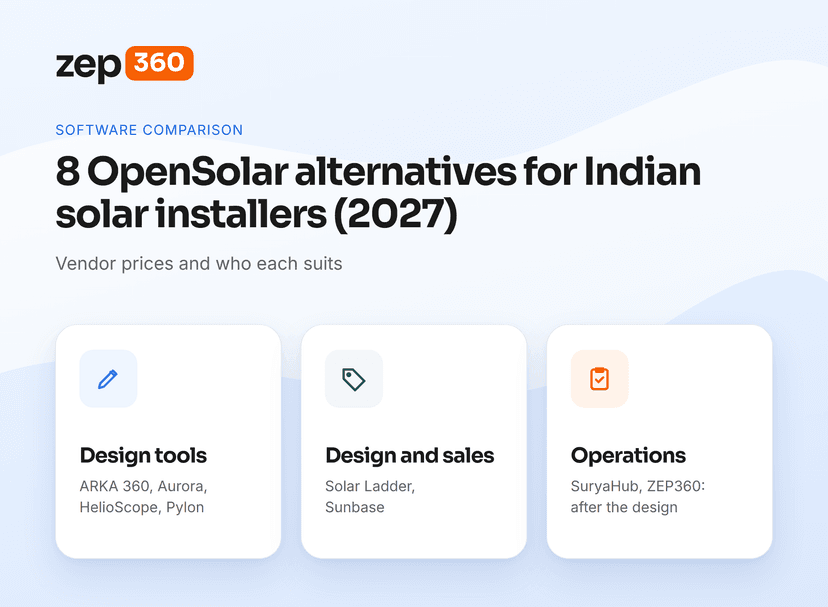


The best OpenSolar alternative depends on whether you need design or the work after it. ARKA 360 lists INR pricing for design and proposals. Aurora Solar is the premium design option, priced in dollars. For surveys, stock, subsidy paperwork and maintenance contracts, look at Solar Ladder, SuryaHub or ZEP360, our own solar project management software.
If you want one system for the whole business, ZEP360 is the closest fit. It covers sales, projects, stock, AMCs and subsidy paperwork in one place, and it connects to your design tool through its API. If you only need a design tool, ARKA 360 is the one that shows rupee pricing, and Aurora Solar is the premium pick if you're happy to pay dollar prices.
Here's the shortlist at a glance, with the job each tool does best.
- ZEP360, best for running the whole EPC business, from survey to AMC, with your design tool connected through its API
- SuryaHub, best for Indian EPCs that want an India-first operations platform and already have a design tool
- Solar Ladder, best for Indian firms that want design, projects and procurement in one Indian-built product
- Sunbase, best for contractors that work across solar, roofing and construction
- ARKA 360, best for design and proposals with rupee pricing
- Aurora Solar, best for premium residential design, billed in dollars
- HelioScope, best for commercial and industrial design and simulation
- Pylon, best for pay-per-project design for Australian installers
Why Indian installers look beyond OpenSolar
OpenSolar is a strong free tool, and it covers more than most people expect: design, proposals, e-signature, a CRM, a project board, invoicing and a supplier shop. Most Indian EPCs start looking elsewhere when they run into one of these limits.
- The work after handover: Its project board can schedule maintenance visits as calendar events, but we didn't see AMC contracts, renewals, SLAs, ticketing or stock by warehouse on its pages.
- Indian compliance: Its India page lists four features (elevated structures for flat RCC roofs, WhatsApp proposal sharing, an interactive 3D view and coordinate search), plus a Hindi option. We didn't see DISCOM workflows, net metering, PM Surya Ghar, GST or rupee pricing.
- Connecting other tools: API access is billed per project and connectors like Xero and QuickBooks are a monthly subscription, so integrating costs money.
- Local coverage: Its Shop suppliers and finance products don't cover India yet, and single-line diagram templates exist for Australia, the US, the UK, Germany, Italy and Spain but not India.
If design is most of your job, OpenSolar may be all you need. If your job is delivering projects and servicing them for years, that's where a platform built for operations earns its place.
How we put this list together
We started with the tools Indian installers and EPCs compare against OpenSolar, then read about 100 pages across the eight vendors' sites: features, pricing, India pages, FAQs and company pages. We checked every price on 28 October 2026.
We haven't tested these tools ourselves, so everything below is what each vendor says on its own pages, plus a few outside reviews. When we say we didn't see something, we mean it wasn't on the pages we read, not that the product can't do it, so confirm with the vendor.
We make ZEP360, so we list it first among the tools that run the whole business, and we say plainly where it isn't the right fit. We grouped the tools by the job they do and ordered each group by fit for an Indian installer or EPC.
The 8 OpenSolar alternatives, grouped by job
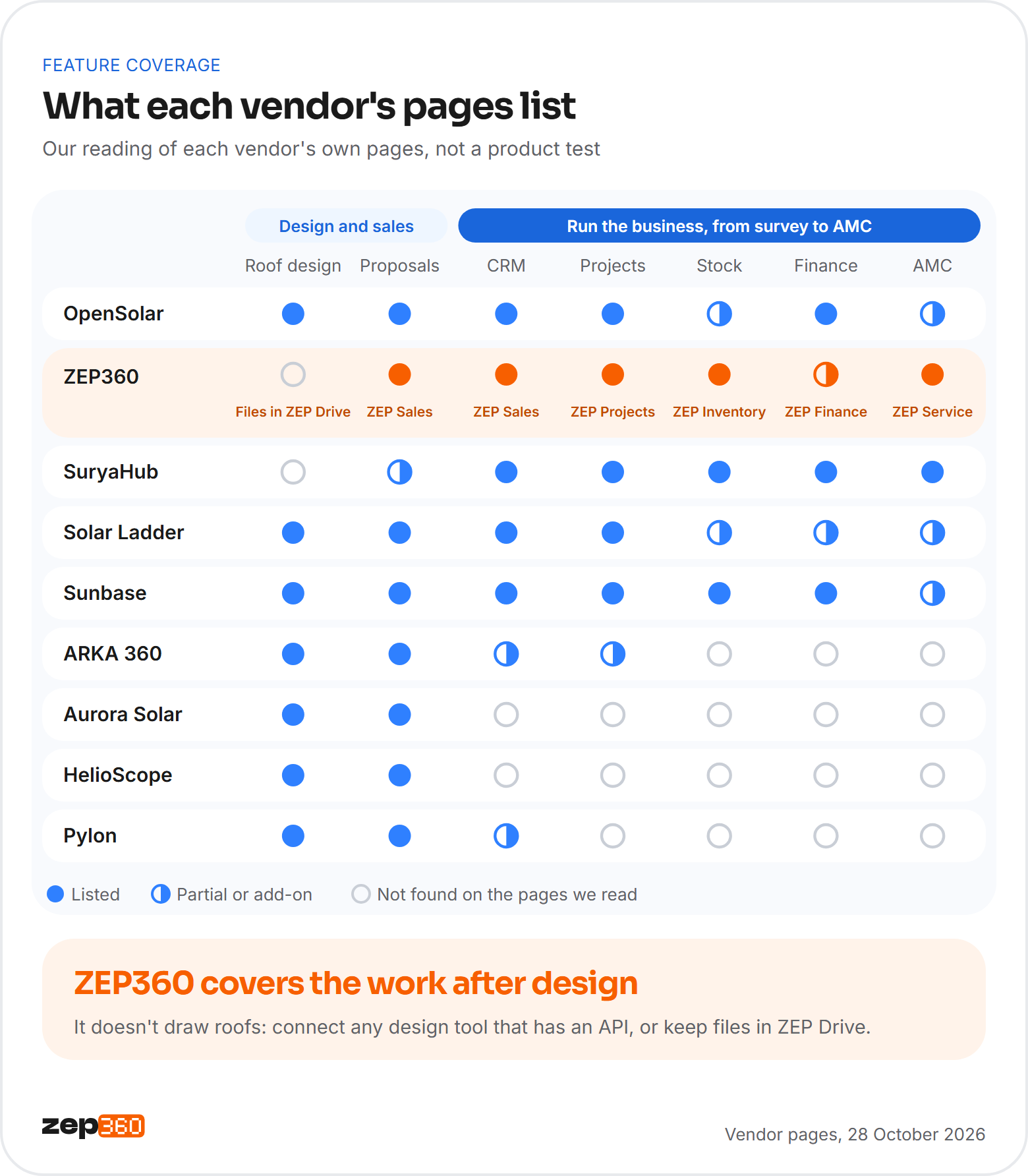
Four of these run the business and four are design tools. The table shows what each vendor's pages list, with OpenSolar at the top for comparison. A filled circle in the figure means listed, a half circle means partial or add-on, and an empty circle means we didn't see it.
1. ZEP360

ZEP360 is the platform for EPC, MEP, solar and field service firms. It's young: we started in January 2025, we're based in Greater Noida and Kochi, and more than 100 businesses run on it. Felix George, our founder, spent 15 years running construction and infrastructure projects in the UAE and India, and co-founder Deepu Sasikumar has 13 years in solar and engineering services (about ZEP360).
Here's what you get, module by module.
- Sales (ZEP Sales): One pipeline for enquiries from WhatsApp, your website, IndiaMART, Justdial and missed calls, with lead scoring by rules you set. Quotations and proposals are built from the survey data, keep their version history and go to the client on WhatsApp, and your field team can capture customer signatures on a phone. See solar CRM software.
- Site survey: A mobile form for roof, shading, load and structure, filled on site with geo-tagged photos, OTP-verified and sent over WhatsApp.
- Projects (ZEP Projects): Gantt, stages, tasks with dependencies, timesheets, budget against actual, and a BOQ generated from a saved template. See EPC project management software.
- Stock (ZEP Inventory): A warehouse for each branch, material requests with approvals, back orders and adjustments, and serial numbers logged through a scanner link. See warehouse inventory management software.
- Subsidy and DISCOM paperwork: Net metering, CEIG clearance and other sign-offs are configurable stages, documents come out in the format each state and DISCOM expects.
- AMCs and support (ZEP Service, ZEP Customer Support): Visits, service tickets, SLA timers, renewal alerts and spare parts scanned from van stock, with complaints logged and assigned so they close before the SLA clock runs out. See AMC management software.
- Money and client view: ZEP Finance tracks payments, expenses and project profitability, and clients get a view-only status page.
Design works like this.
- You keep your design tool: ZEP360 doesn't draw roof layouts or run shading simulations, so you design in the tool you already like.
- It connects by API: We can connect to any design tool that offers API integration. What that costs depends on the design tool's own terms: OpenSolar bills API access per project, Aurora Solar and HelioScope list APIs on Enterprise, and ARKA 360 lists API integration on its Premium plan.
- Files stay together: ZEP Drive keeps every project file, design files included, in one project folder, and drawings are version-controlled.
- Ask before you commit: We don't publish API documentation, so ask us which design tools you want to connect with.
A few other things to know before you book a demo.
- Pricing: There's no public price list. You pick a package (Sales Pro, Business Pro, Business Plus, Business Max or Business Complete), add users and choose optional add-ons such as GPS Tracking and External Sales. Onboarding, team training and ongoing support come with every plan (ZEP360 pricing).
- Security: Data is encrypted in transit and at rest, access is role-based with least privilege, security events are logged and monitored, and you keep ownership and export rights to your data. We don't publish certifications or a hosting region.
- India fit: Indian lead sources, DISCOM formats, net metering, CEIG stages and MNRE documents are covered. Our site doesn't list GST invoicing, PM Surya Ghar by name or a Hindi interface, so ask us about those in a demo.
- Best for: EPCs that want sales, projects, stock, subsidy paperwork and AMCs in one system.
- Skip it if: You want roof design in the same tool, or you need a published price list before talking to anyone.
2. SuryaHub
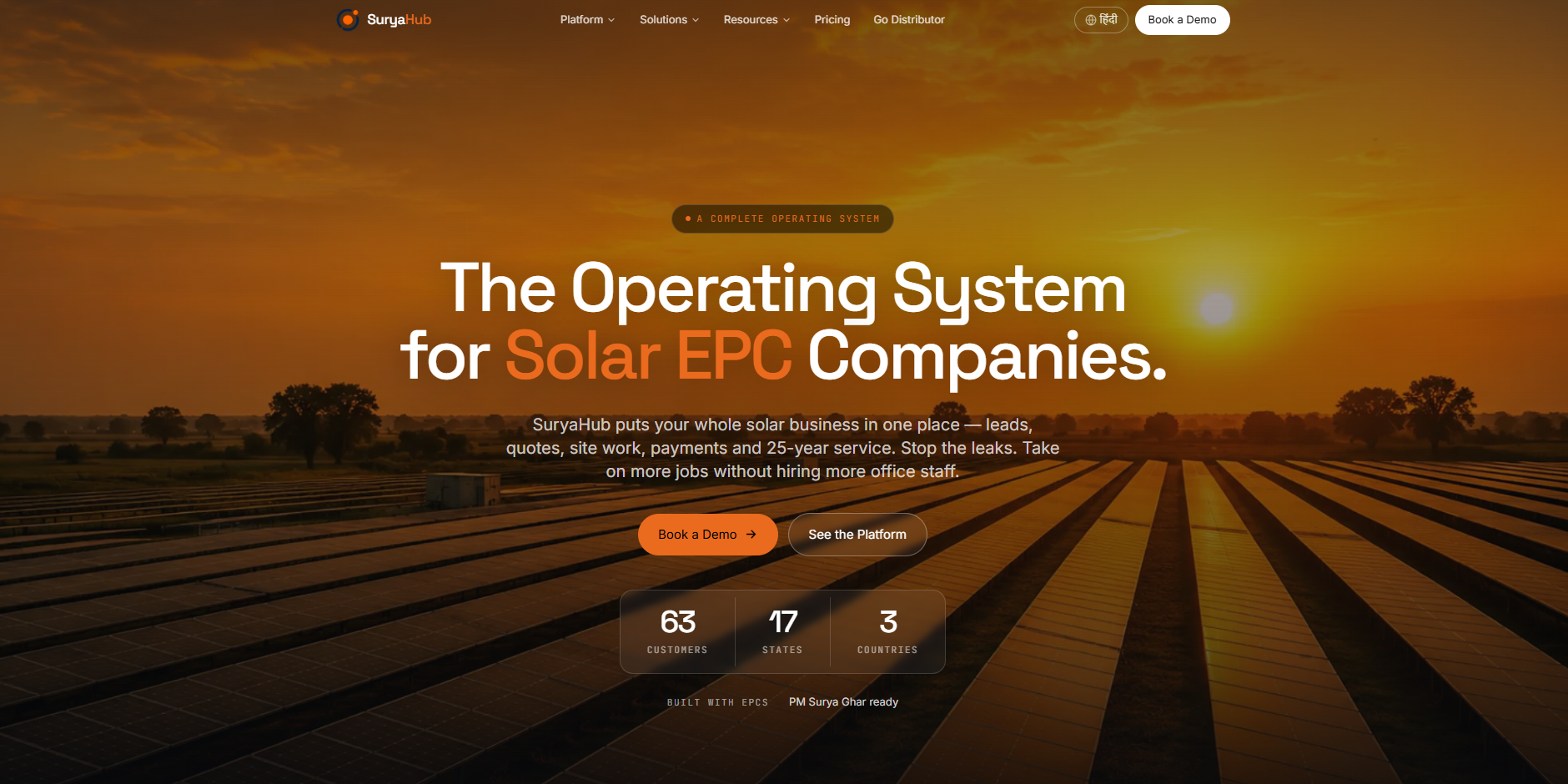 SuryaHub is an Indian solar EPC platform built in Jaipur that runs a job from first lead to quote, install and 25-year AMC. It says it has 63 customers across 17 states and a team of nine, and it calls itself early. It's the closest competitor to ZEP360.
- Leads and quotes: Leads from website forms, WhatsApp, Facebook and Instagram land in one inbox, and quotes are priced from your own rate cards and bill-of-material templates, with GST and PM Surya Ghar subsidy shown.
- Projects and stock: A job file with stages and a three-level approval, plus purchase orders, warehouse transfers, delivery notes and batch and serial tracking.
- Money: GST invoices (CGST, SGST and IGST), milestone payments and project P&L. It says it isn't accounting software, and Tally is a paid add-on.
- AMC: Auto-scheduled visits, spare-parts tracking, renewal reminders at 90, 60 and 30 days and a customer self-service portal.
- India fit: The strongest here, with DISCOM and net-metering documents, PM Surya Ghar tracking, ALMM and DCR records and Hindi. It doesn't file on the government portal or release subsidy.
- Design: It has no PV design, shading or 3D engine. A paid Design API connects tools such as PVsyst, Aurora, OpenSolar or ARKA 360.
- Pricing: One yearly plan plus a one-time implementation fee, quoted in rupees plus 18% GST after a demo. Its pages disagree on whether Lite, Elite and Pro tiers exist and on whether its AI chatbot is live, so confirm both in the demo.
- Best for: Indian EPCs that want an India-first operations platform and already have a design tool.
- Skip it if: You want design inside the same product, or need pricing before a demo.
3. Solar Ladder
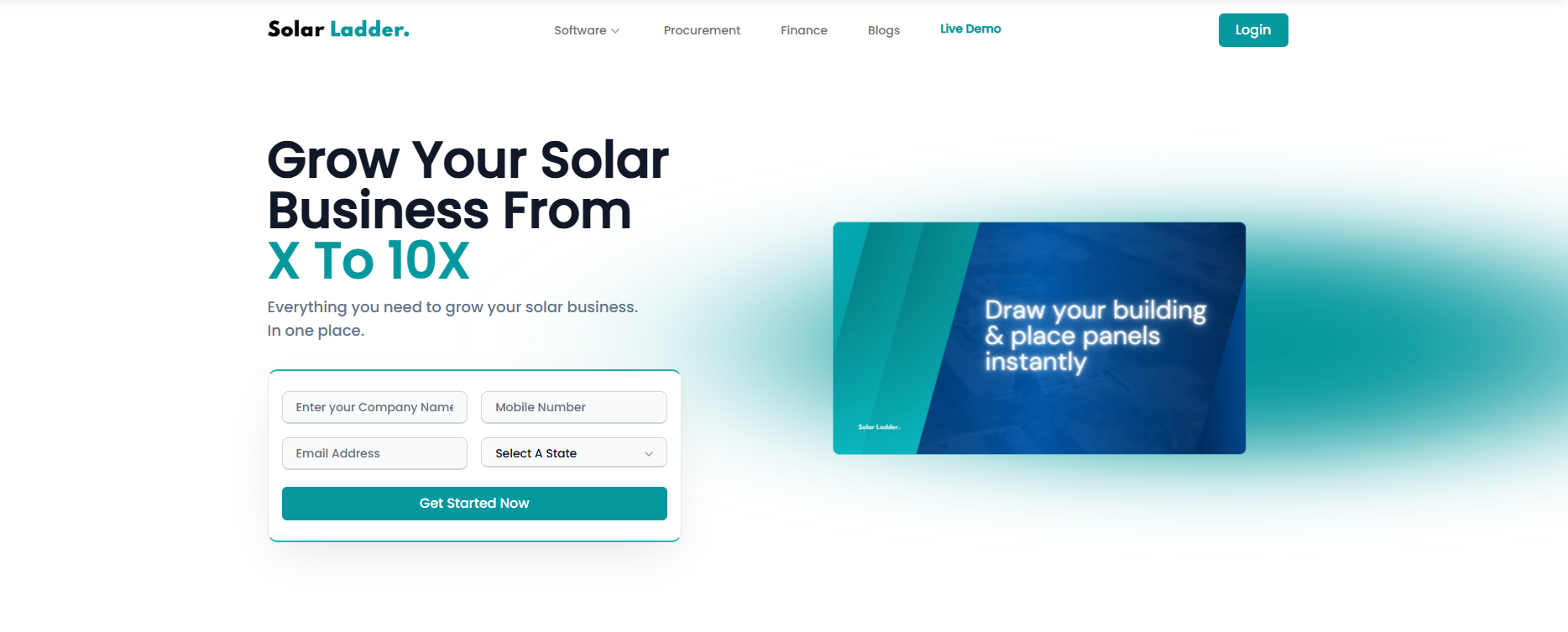 Solar Ladder is a Mumbai platform, run by Abhimanhan Energy Private Limited, that calls itself the operating system for solar. It was founded in 2021 and raised an INR 11 crore seed round in 2023 from investors including Axilor Ventures, Titan Capital, DeVC and Stride Ventures. Its site claims more than 600 companies, 70,000 projects managed and 85,000 proposals made, which are its own figures.
- Design and proposals: it says a design takes about 2 minutes, with a shareable 360-degree preview, a mobile app, shadow analysis and satellite imagery you trace by hand. An AI tool reads an electricity bill to fill in sanctioned load, tariff category and monthly units, and proposals go out by WhatsApp, email, PDF or web link.
- Operations: A CRM, project management with stages and tasks, Books for inventory, costing, expenses and invoicing, materials procurement, site-survey forms and a customer dashboard.
- O&M: It says it has the most thorough O&M software in the industry, and its blog mentions preventive maintenance, technician scheduling, warranty tracking and AMC management. We didn't find dedicated pages for O&M, procurement or the dashboard, so ask for a demo of each.
- Finance: Its finance arm lists solar loans, with working capital up to ₹1 crore.
- India fit: A state selector, rupee loan pages, PM Surya Ghar and net metering in its blogs, and integrations with Google Calendar, Google Forms, Zoho and IndiaMART. We didn't see a subsidy tool, a DISCOM application module, named GST invoicing or Hindi.
- Gaps: We didn't see battery design, single-line diagrams or hourly yield simulation.
- Pricing: No public prices. Inc42 reported in 2023 that the software was free with paid premium modules and that it was a small part of revenue, so ask what applies today.
- Best for: Indian solar firms that want design, CRM, projects and procurement in one Indian-built product.
- Skip it if: You need published pricing, a documented API or engineering-grade yield reports.
4. Sunbase
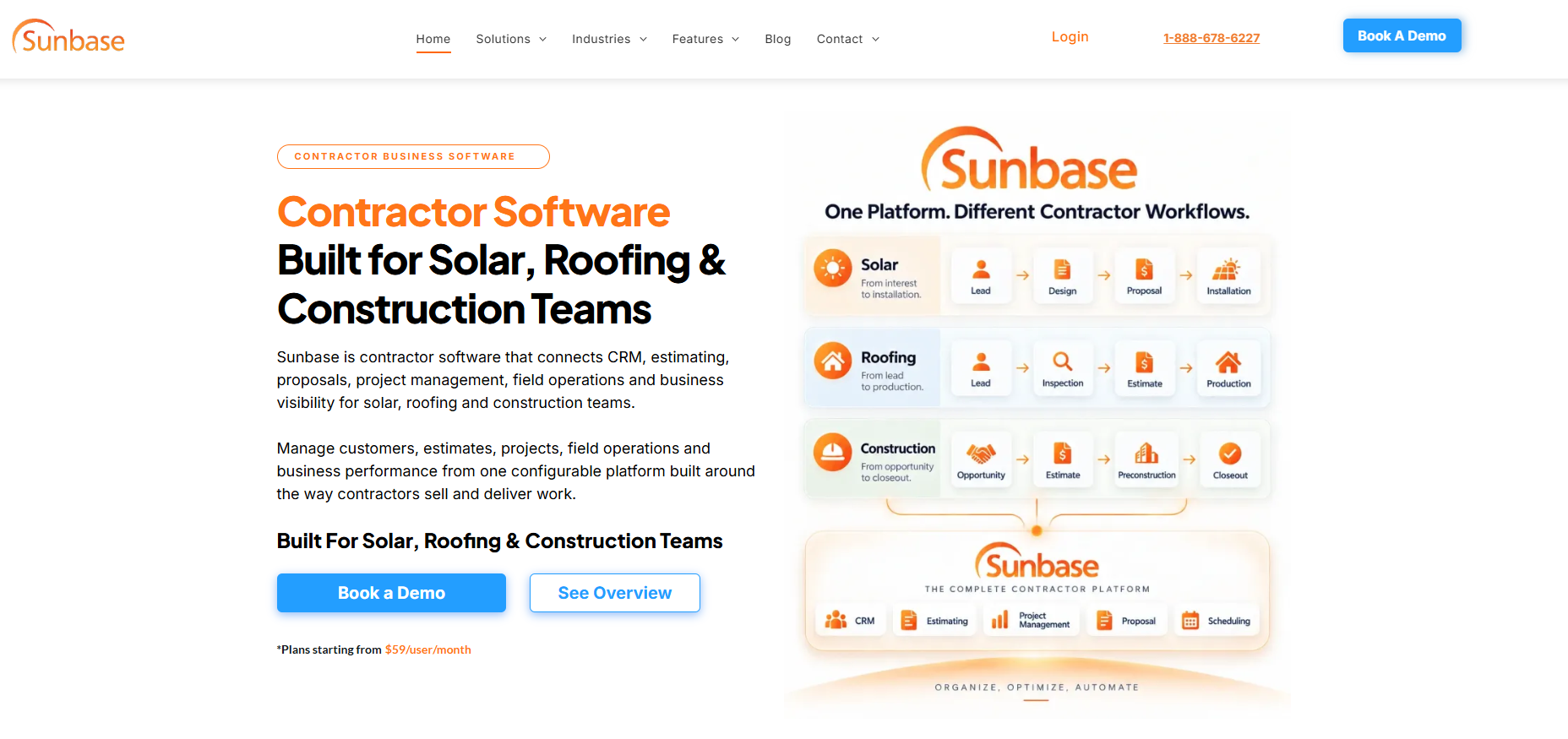 Sunbase is a US contractor platform for solar, roofing and construction, founded in 2011 and based in Florida. It claims more than 100,000 projects managed and over 8,000 contractors using it daily.
- Design: Rooftop, canopy and ground-mount layouts, roof planes, obstructions, shading and production estimates. It doesn't name an imagery source or simulation engine, and its own comparison page concedes that Aurora leads on bankable shade reports and complex engineering.
- Sales: Pipelines, follow-ups and automation, a door-to-door sales app, and proposals with layout, shading report, production, equipment, pricing, financing and savings. It says it supports e-signing and financing through GoodLeap and LightReach.
- Operations: Project stages, tasks, crews, inspections and interconnection tracking, inventory across warehouses, and finance with a ledger, quotes to invoices and sales commissions.
- Service: Service requests with assigned technicians. We didn't see AMC contracts or renewals, GST handling or a procurement module.
- Pricing: From $59 per user a month, with no fixed tiers, so the price depends on users, modules, workflows and implementation. We didn't see a free plan or a trial.
- India fit: One line says it supports teams in India, but its pages use US terms such as PTO and interconnection and show a US phone number. We didn't see INR, GST, DISCOM, net metering, PM Surya Ghar or Hindi.
- Reviewers: A SourceForge user praises ease of use and proposals and notes a learning curve.
- Best for: Contractors that sell and run jobs in several trades and want one US-style suite.
- Skip it if: You need Indian compliance workflows or deep design.
5. ARKA 360
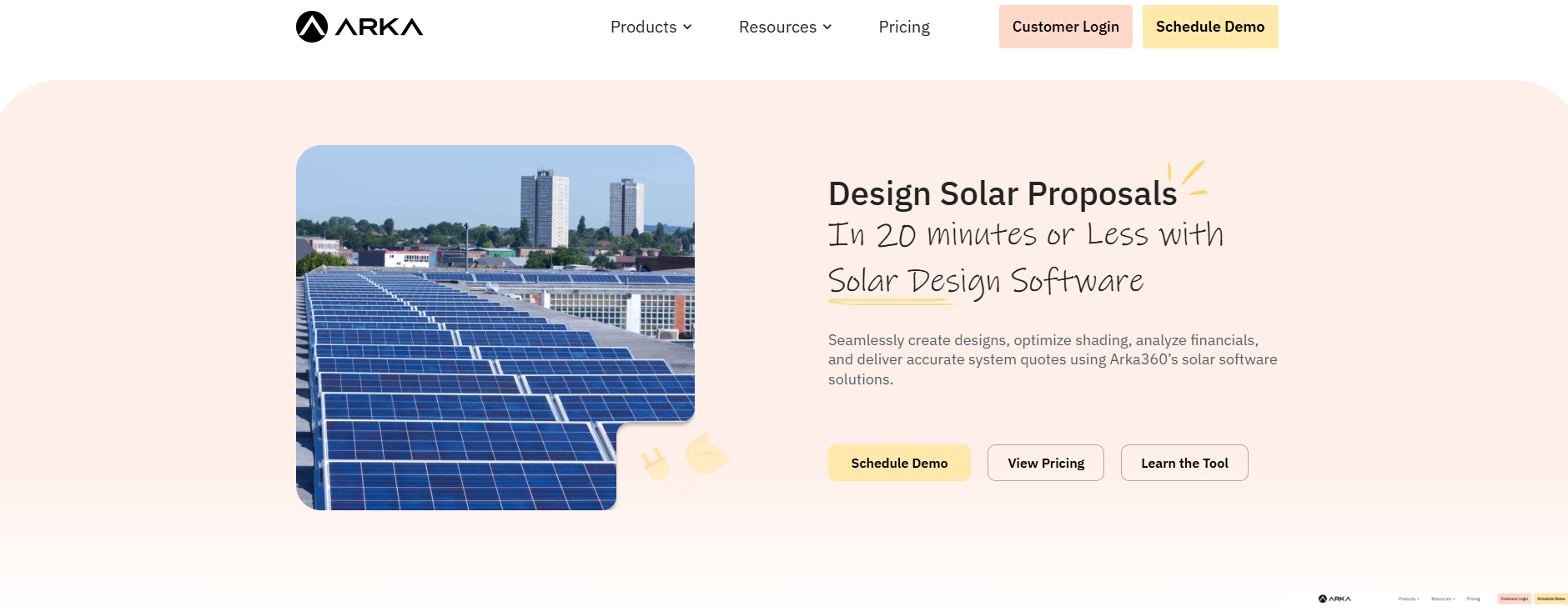 ARKA 360 is a solar design and proposal platform with offices in Bengaluru and Allen, Texas. It says more than 4,000 installers use it across 27 countries, though its home page says 25, so treat the counts as claims.
- Design: 3D modelling, shading simulations, automated sizing and battery modelling, with AI-optimized designs in about five minutes by its own account.
- What each INR plan adds: Lite has a shading report, 3D visualization, PV layout CAD export, sales proposals and a generation report, capped at 360 residential projects. Basic adds unlimited residential and commercial projects and micro-inverter design. Premium adds single-line diagram export, optimizer design, manual stringing, SketchUp and PVsyst export and API integration.
- Proposals: Financial breakdowns, ROI calculations, 3D visualisations and a QR code that shows the layout on the rooftop. It also lists dealer fees, loan products and loan applications.
- CRM: An add-on on all three INR plans, with automated follow-ups and dashboards. We didn't see inventory, procurement, finance, AMC or e-signature.
- Pricing: Lite is ₹7,500 a month or ₹46,000 a year, Basic ₹11,500 or ₹70,000, and Premium ₹16,500 or ₹1,00,000, all plus 18% GST. The page doesn't label which figure is monthly, it mixes in dollar plans and it carries a January 2025 banner. A software directory lists $159, $199 and $999 a month, so confirm in writing.
- India fit: Rupee pricing with GST, a Bengaluru office and Indian case studies, including IIT Mandi. We didn't see DISCOM, net metering, PM Surya Ghar, ALMM or Hindi.
- Best for: Small and mid-sized Indian installers that want design and proposals in rupees.
- Skip it if: You need stock, project budgets or maintenance contracts in the same system.
6. Aurora Solar
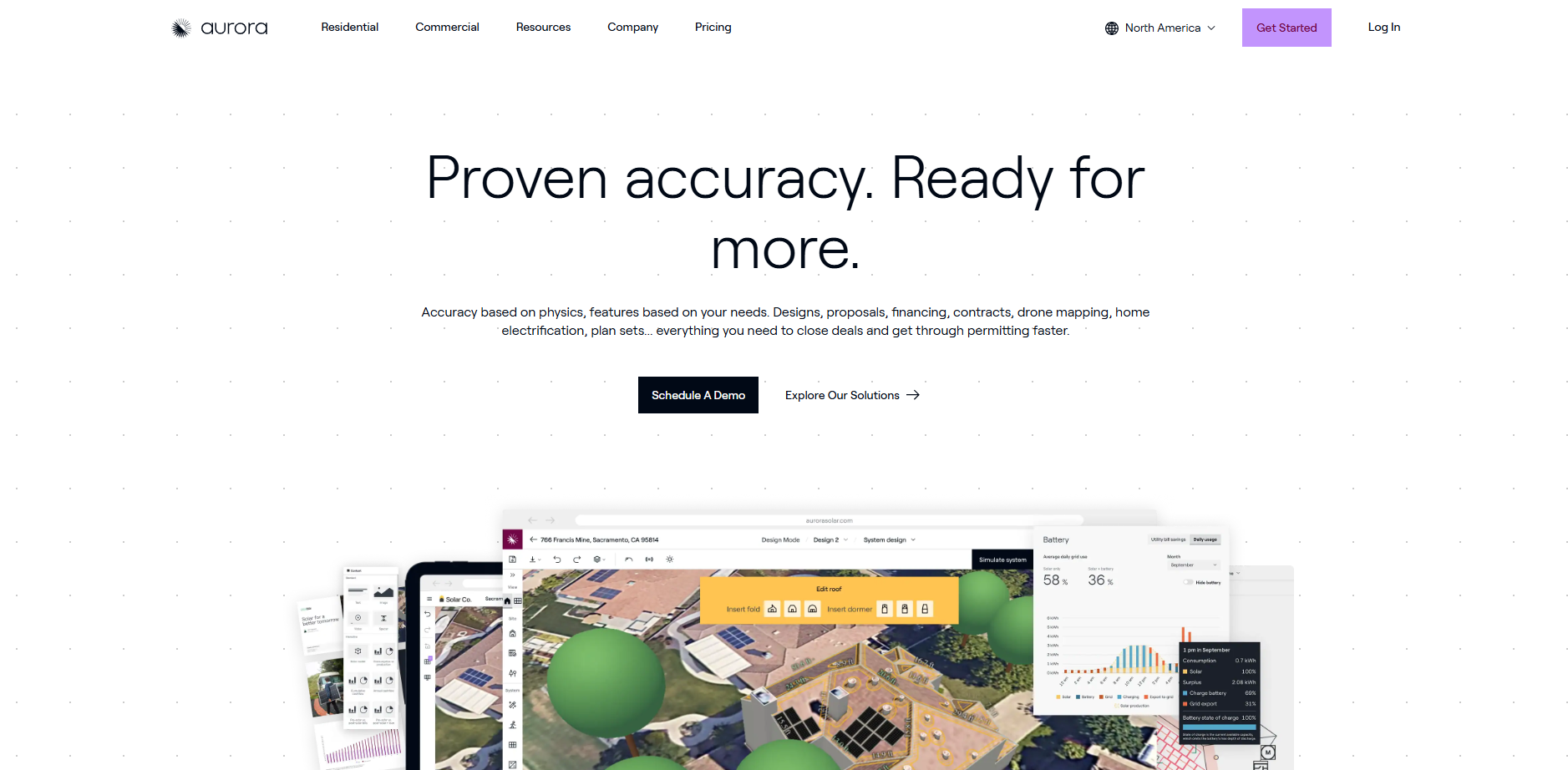 Aurora Solar is a residential-led design and sales platform, founded in August 2013, with HelioScope as its commercial product. It claims more than 7,000 solar organizations and over 20 million projects designed, and it has raised large rounds, including a $20 million Series A in February 2019 and a $250 million Series C in May 2021.
- Design: Remote site assessment, LIDAR-based shade analysis, AI-assisted 3D modelling, automatic module and inverter placement, NEC validation reports, automated stringing, ground mounts and battery modelling, plus a database of more than 25,000 US permitting jurisdictions.
- AI roof models: Built from an address and a utility bill. Its pages quote 10, 15 and 60 seconds for this, so treat the speed as a claim.
- Plan sets: Instant where available, or a service that delivers in 24 to 48 hours.
- Sales: A drag-and-drop proposal editor and storage modelling, financing integrations with LightReach, GoodLeap, Mosaic, Dividend, Sungage Financial and EnFin, and DocuSign through Contract Manager.
- Operations: We didn't see a CRM, project, finance or AMC module. It integrates with other CRMs instead.
- Pricing: Basic is $159 per user a month ($1,620 billed annually, or $135 a month) and Premium is $259 ($2,640 billed annually, or $220 a month). Both cover one user and 50 projects a month. Enterprise is custom, with unlimited users, APIs and drone mapping, and on-demand site models start at $9.99. We didn't see a free trial.
- India fit: Nothing we could see, since it's built around US practice.
- Reviewers: Contractor Software Hub, whose site carries affiliate links, calls it the strongest paid design and sales platform for growing residential and mixed-use installers. Its drawbacks are the 1-user, 50-project cap, add-ons that raise the real cost, and permit plan sets that need an external AutoCAD license.
- Best for: Teams that design in the US style and bill in dollars.
- Skip it if: You want rupee pricing, a CRM in the same tool, or a low per-user cost for a large team.
7. HelioScope
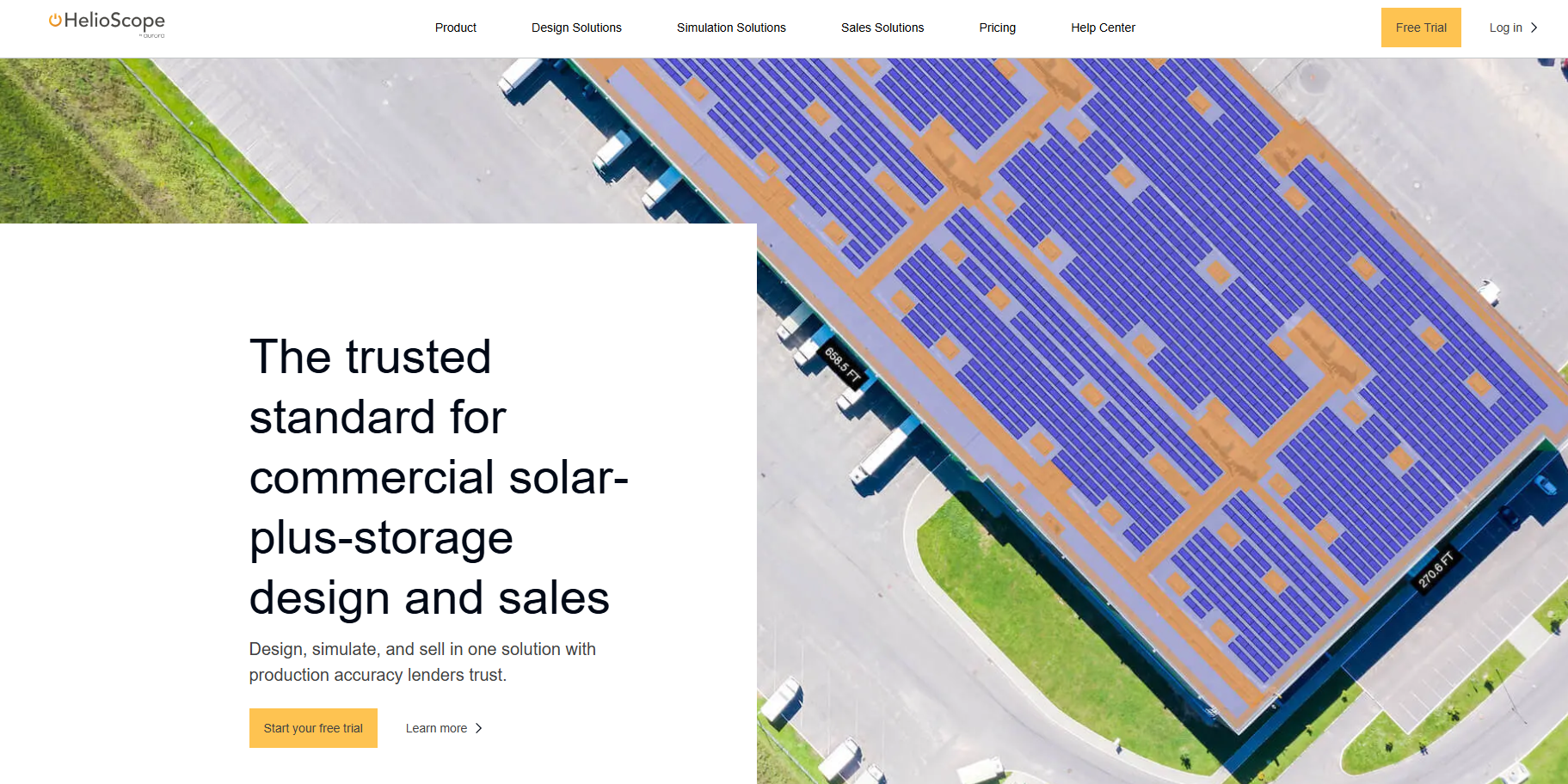 HelioScope is Aurora's commercial product, built for commercial solar-plus-storage design, and it says its simulation is validated by DNV, NREL and CEC.
- Design: Rooftop, carport and ground-mount arrays plus storage in one project, with a CAD-style interface, automatic layout and shading analysis.
- Simulation: An 8760 production report, weather data from 8 common sources and P90, P95 and P99 values on Pro. It says estimates come within 1% of PVsyst, which is its own claim.
- Pro adds: LIDAR-assisted modelling, storage modelling, financial modelling with IRR and LCOE, and customizable proposals.
- Size caps: 1.25 MW DC on Basic, 5 MW on Pro and 30 MW on Enterprise.
- Operations: We didn't see a CRM, projects, stock, finance or AMC.
- Pricing: Basic is $159 per license a month ($1,620 a year) and Pro is $259 ($2,640 a year). Each covers one user and 10 projects a month, 120 a year. Enterprise is custom and adds trackers, PVsyst export, API and single sign-on. A free trial is offered, with no terms shown.
- India fit: Nothing we could see, and prices are in dollars.
- Reviewers: Apps List Solar notes that full electrical documentation still needs AutoCAD and that it's weaker for residential work. Creative Nurds, in a review last updated in February 2023, said it suits large installations and recommended other tools below about 15 kW.
- Best for: Engineers modelling commercial and industrial projects for lenders.
- Skip it if: Your work is mostly residential rooftops, or you need anything beyond design and financials.
8. Pylon
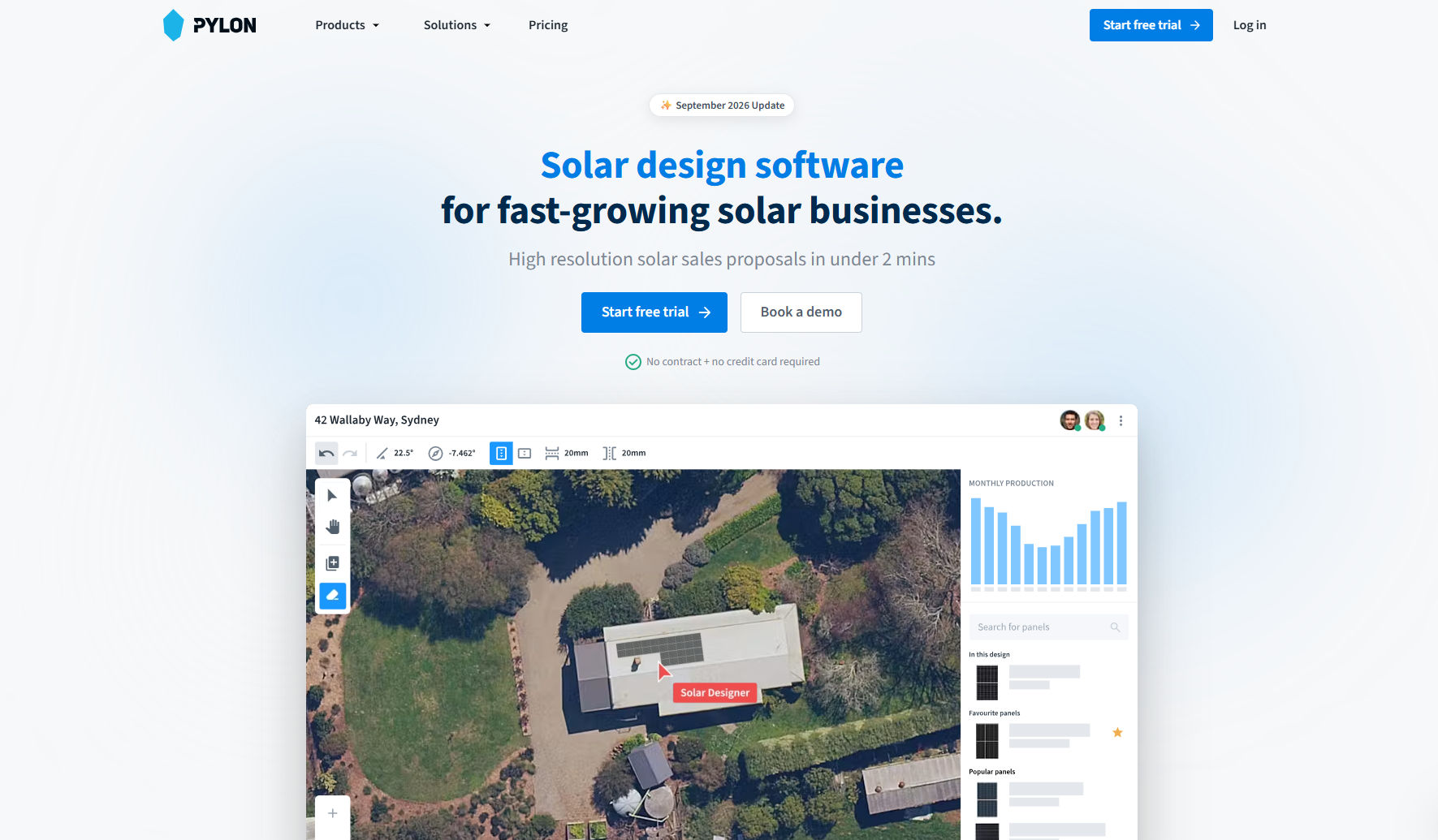 Pylon is a pay-per-project solar design tool made in Sydney by Saru Technologies Pty. Ltd., and its pricing page says you only pay for what you use.
- Design: Panels on high-resolution aerial imagery where available, 3D shading analysis, financial projections, interval data analysis, and instant web and PDF proposals. It lists more than 20,000 panels, inverters and batteries.
- Single-line diagrams and batteries: Single-line diagrams are generated from the design with no per-diagram fee, and battery design simulates off-peak charging and days of autonomy.
- Limits: Standard projects are capped at 30 kW DC, and Pro and Enterprise go to 99 kW or more.
- Sales: Digital signatures cost 80c a project, a payment gateway charges 2.50% a transaction including GST, and finance integrations are Brighte, Smart Ease and Solaris Finance.
- Operations: A CRM add-on from $49 per user a month, and integrations with Xero and ServiceM8. We didn't see project management, stock, finance or AMC.
- Pricing: Standard is $4 per project and Pro is $10. New users get free credits for five Standard projects with no credit card, there's no monthly minimum and users are unlimited. The page shows only a dollar sign, with no currency, and doesn't say whether GST is included.
- India fit: Nothing we could see. Its pages cite the Australian standards AS/NZS 5033:2021 and 5139:2019 and list Australian lenders.
- Reviewers: Solar Proof, which sells competing software, called it firmly residential and built for the Australian market in June 2026.
- Best for: Small installers in Australia that want low-cost design billed per project.
- Skip it if: You install in India.
India fit: what each vendor's pages show
For an Indian installer, the real test of a platform isn’t the design. It’s whether the paperwork gets finished and the approvals come through without the project stalling. Here’s how the tools compare on that.
ZEP360: yes, we’re built for Indian solar projects
Approvals and documentation are part of every solar project in ZEP360, not an add-on. Here’s how that works day to day.
- Documents for every project: Completion reports, MNRE documents, scheme agreements and application forms come out of the project record in a few clicks, in the format each state and DISCOM expects. ZEP360 already holds your survey, quotation, procurement and installation data, so nobody retypes it.
- DISCOM and net-metering approvals: Net metering, CEIG clearance and any other sign-off is a stage on the project, so you can see what’s waiting and who owns it.
- Government portals: An auto-form-filling tool fills portals that have no direct API, using the data already in your project.
- Subsidy paperwork: Subsidy documents and application forms are generated from the same project record.
- Everything easy to find: ZEP Drive keeps every project file, design files included, in one project folder with version control. Clients get a view-only status page, so you get fewer “where is my project” calls.
- Finished accurately and on time: Because documents are built from data you’ve already captured, there’s less retyping and fewer mistakes. Every stage is tracked in ZEP Projects with tasks, timelines and budget against actual, so delays show up early.
- Built for how you work in India: Enquiries from WhatsApp, IndiaMART and Justdial, survey forms sent over WhatsApp, and offices in Greater Noida and Kochi.
How the others compare
- SuryaHub: the closest on Indian approvals, with DISCOM and net-metering documents, PM Surya Ghar tracking and ALMM and DCR records. It doesn’t file on the government portal, and you need a separate design tool.
- Solar Ladder: it mentions PM Surya Ghar and net metering in its blogs, but we didn’t see a dedicated approvals module.
- ARKA 360: it shows rupee pricing, but we didn’t see DISCOM or approval workflows.
- OpenSolar, Aurora Solar, HelioScope, Pylon and Sunbase: we found nothing on DISCOM approvals or Indian subsidy paperwork. OpenSolar’s India page lists elevated structures, WhatsApp proposals, an interactive 3D view and coordinate search.
How to choose between them
Four situations cover most Indian installers and EPCs.
- You run projects, stock, subsidies and AMCs: compare ZEP360, SuryaHub and Solar Ladder on a demo with one of your own projects. Solar Ladder lists design alongside procurement and finance, SuryaHub centres on Indian compliance, and ZEP360 centres on EPC project and service operations.
- You do residential rooftops and want free design: OpenSolar is a strong place to start. Add other tools only when you hit a gap.
- You want design and proposals in rupees: ARKA 360 is the one design tool here that shows INR pricing with GST, so confirm the current prices first.
- You model commercial projects for lenders: HelioScope is built for that, and Aurora Solar suits dollar-billed residential teams.
Many firms pair one design tool with one operations platform, and SuryaHub's own page says so too. Whichever route you take, run three real jobs through a trial before you commit.
Questions to ask any vendor
Get these answered in writing before you sign.
- What does the price include, in rupees, and is GST on top?
- Which modules are in my package, and which are add-ons?
- Can I export all my data, and in what format?
- Does it produce DISCOM, net-metering and subsidy documents in the formats my state expects?
- Who supports me in India, in which hours and language?
- How long does go-live take, and what does it cost?
Moving off OpenSolar: what to plan for
Three facts from OpenSolar's pages matter if you add or switch tools.
- Export first: its Trust Center says customers can request a data export or deletion.
- Integrations cost money: its API is billed per project, so connecting it to another system has a running cost.
- India gaps stay gaps: its Shop, finance products and single-line diagram templates don't yet cover India, so those workflows won't carry over.
Export your customers, projects and price lists first, run both systems side by side for one billing cycle, and move maintenance contracts last.
See what happens after the design is done
If your work runs from site survey to stock to AMC management software, we'll walk you through ZEP360 on your own projects. You can also read more on our solar business software page.
Frequently asked questions
What is the best OpenSolar alternative for Indian solar installers?
It depends on the job. ZEP360 runs a whole EPC business and says it can connect to any design tool with an API. ARKA 360 lists INR pricing for design. Solar Ladder and SuryaHub also cover Indian solar operations.
Is there an OpenSolar alternative with INR pricing?
Yes. ARKA 360's pricing page lists plans from ₹7,500 a month, or ₹46,000 a year, plus 18% GST. SuryaHub quotes in rupees after a demo. Aurora Solar, HelioScope, Pylon and Sunbase publish dollar prices.
What is the best OpenSolar alternative for commercial projects?
HelioScope is built for commercial solar-plus-storage design, and says its production estimates are validated by DNV, NREL and CEC. ARKA 360's Basic and Premium plans include unlimited commercial projects. Compare both on one real project.
What is the best free solar design software?
OpenSolar's core design tools are free, which suits small residential work. Pylon gives free credits for five standard projects, and HelioScope offers a free trial. After that, check what each tool charges and who pays for it.
Can solar proposal software also run projects and stock?
Some can. Solar Ladder lists projects, procurement and O&M, and Sunbase lists inventory and project management. Aurora Solar and HelioScope focus on design and sales. ZEP360 covers stock and AMCs, not roof design, so pair it with a design tool.
Can I use OpenSolar and another tool together?
Yes. SuryaHub says many EPCs keep OpenSolar for design and add its platform for operations. ZEP360 works the same way: it says it can connect to any design tool with an API and keeps design files in ZEP Drive.
Is OpenSolar really free?
OpenSolar says its core software is free and will always be free, with partners funding the platform. API access and connectors are paid add-ons, so check those edges first. We cover who pays for OpenSolar in a separate post.
Does OpenSolar support PM Surya Ghar or DISCOM workflows?
Not on the pages we read. OpenSolar's India page lists elevated structures for flat RCC roofs, WhatsApp proposals, an interactive 3D view and coordinate search. SuryaHub and ZEP360 describe DISCOM and net-metering workflows on their pages.
Which OpenSolar alternatives publish their prices?
ARKA 360, Aurora Solar, HelioScope and Pylon publish prices, and Sunbase publishes a starting price. SuryaHub quotes after a demo, and Solar Ladder and ZEP360 publish none. Confirm every price in writing before you budget.
What should an Indian EPC ask before switching from OpenSolar?
Ask what the price includes in rupees and GST, which modules are add-ons, whether you can export all your data, and whether the tool produces DISCOM and subsidy documents in your state's format. Then run three real jobs.
Does OpenSolar manage AMC contracts or customer support tickets?
Not on the pages we read. OpenSolar's project board can schedule maintenance visits as calendar events, but we found no AMC contracts, renewals, SLAs or ticketing. Some firms connect other tools through its paid API.
- Solar Business Management
- Solar Business Growth


